In the past four decades, 459 deaths and 41 attempted homicides are believed to be linked to serial killers who are using the nation's highways to find and dispose of their victims.
Tuesday, October 05, 2010
In the past four decades, 459 deaths and 41 attempted homicides are believed to be linked to serial killers who are using the nation's highways to find and dispose of their victims.
Tuesday, September 07, 2010
She-devil
Friday, August 01, 2008
Saturday, July 19, 2008
[Update: Monday, July 21 -- I.R Iran's final Revue game vs. Utah Jazz was webcast on NBA.com. You can watch it here. Thanks for your support.]
Saturday, July 19 -- The Rocky Mountain Revue each year features up-and-coming basketball players in summer league competition. This year's Revue includes several NBA teams, an NBADL select team, and the Iranian National Team. So, the natural question is: Who dropped the ball on that one? Amidst the Bush administration's lengthy political wrestling match with Tehran, how did the NBA get away with inviting Iran's team to play summer league ball?
The answer is surprisingly simple. The Revue had a standing commitment to FIBA to include the Asia Continental Champion, which everyone expected would be China. Without superstar center Yao Ming, the Chinese team failed to advance, and Iran went on to defeat Lebanon in the championship. Iran? They haven't been competitive in basketball for more than 30 years.So, the NBA, desperately needing some positive publicity (and with approval from the U.S. State Department), invited Iran to participate. And the Iranians, perhaps thinking it was all a joke, accepted. So, after more than a year of nuclear fear-mongering by the American media portraying Iran as our most imminent and dangerous enemy, we invited them to come over and play some pickup games? Brilliant!
Fast-forward to today, as the Iranians faced the Dallas Mavericks' summer league team in competition. If you have never been to Salt Lake City in July, it's 130 degrees, and there's not much going on other than the Revue. Also, it's not the most colorful town. And by that I mean it's mostly white folks out there in the desert. Usually.
But not today. Today the sand-colored crowd packed the gym at Salt Lake Community College to support Team Iran. They came from California, Florida, New York and Canada. They showed up two hours early with flags and banners and tambourines and cheered and chanted and sang until the very end. The Iranian team lost, but you wouldn't know it unless you were looking at the scoreboard. And I wasn't.
I was looking at the screen of my laptop, trying to find the webcast of the game through the Revue's website. Alas, I was later informed that the games would be neither webcast nor televised. I was suprised, since all of the NBA summer league games from Las Vegas were made viewable online, I assumed the Revue would be also. Certainly this tournament featuring the Iranian team on the soil of the Great Satan merits a webcast at the very least.
Then I began to notice a pattern. Revue officials did nowhere mention that Iran was participating in the tournament until opening day--all event programming listed the Iranian team as "FIBA Asian Champion." If you weren't a regular fan of Team Iran, there was no word of their participation until just a few days before the tournament. And finally, the passionate pro-Iran crowd was denied witness by national audiences, or any audiences for that matter. Why?
Why invite Iran to participate, go through the trouble of arranging the media circus and maximizing the public relations opportunities when nobody outside of the SLCC gym will be able to watch the game? If this was in fact the bold offering of goodwill that the U.S. State Department claims it to be, why back off now? So far, nobody is offering any simple explanations. The Utah Jazz, which organize and manage the Revue, offered their official statement on the matter as "No comment."
To me personally, it seems that perhaps someone didn't want the nation to see its Iranian-Americans waving Iranian flags and chanting in Farsi from the Mormon heartland. Perhaps that same someone wants us to believe that Iranians are some distant, foreign enemy, and not our neighbors or pickup-game teammates. And, as Americans, perhaps we should ask why that is.
During the course of certain events, there are moments, however fleeting or seemingly insignificant, that ultimately transcend our shared humanity. Journalists have often reflected on the the role that sports play in helping conflicted people resolve their differences. In 2006, a civil war in the Ivory Coast was put on hold to allow the embattled nation's soccer team to qualify for the World Cup. I can't help but feel that if any sport does indeed wield such tremendous influence, that influence is being egregiously wasted.Today, I watched players representing my hometown exchange gifts and hugs with players representing my homeland. Today, I witnessed two nations with a long and storied history of polar ideologies put their differences aside, and not for some grand design, but for a simple basketball game. It makes me want to believe that anything might be possible. Well, maybe anything except watching the game on TV.
Thursday, June 26, 2008
Friday, June 06, 2008

"A lot of times in politics you have people look you in the eye and tell you what's not on their mind."—
"Too many good docs are getting out of the business. Too many OBGYNs aren't able to practice their love with women all across this country."—
"I'm honored to shake the hand of a brave Iraqi citizen who had his hand cut off by Saddam Hussein."—
"I welcome you all to say a few comments to the TV, if you care to do so."—Washington D.C., December 7, 2007
"If you've got somebody in harm's way, you want the president being ... making advice, not ... be given advice by the military, and not making decisions based upon the latest Gallup poll or focus group."—
"Our enemies are innovative and resourceful, and so are we. They never stop thinking about ways to harm our country and our people, and neither do we."—
"They misunderestimated me."—
"And so, General, I want to thank you for your service. And I appreciate the fact that you really snatched defeat out of the jaws of those that are trying to defeat us in
"Families is where our nation finds hope, where wings take dream."—Lacrosse, Wisc., October 18, 2000
"I hear there's rumors on the Internets that we're going to have a draft."—
"I know the human being and fish can coexist peacefully."—
"And so the fact that they purchased the machine meant somebody had to make the machine. And when somebody makes a machine, it means there's jobs at the machine-making place." —
We want people owning their home — we want people owning a businesses." —
"A lot of times in politics you have people look you in the eye and tell you what's not on their mind." —
"I'm oftentimes asked, What difference does it make to
"In other words, he was given an option: Are you with us or are you not with us? And he made a clear decision to be with us, and he's acted on that advice." —on President Pervez Musharraf,
"We're going to — we'll be sending a person on the ground there pretty soon to help implement the malaria initiative, and that initiative will mean spreading nets and insecticides throughout the country so that we can see a reduction in death of young children that — a death that we can cure." —Washington, D.C., Oct. 18, 2007
"All I can tell you is when the governor calls, I answer his phone." —San Diego, Calif., Oct. 25, 2007
"I fully understand those who say you can't win this thing militarily. That's exactly what the
"My job is a decision-making job, and as a result, I make a lot of decisions." —The Decider,
"I got a lot of Ph.D.-types and smart people around me who come into the Oval Office and say, 'Mr. President, here's what's on my mind.' And I listen carefully to their advice. But having gathered the device, I decide, you know, I say, 'This is what we're going to do.'" —
"As yesterday's positive report card shows, childrens do learn when standards are high and results are measured." —on the No Child Left Behind Act, Washington, D.C., Sept. 26, 2007
"We're also talking to different finance ministers about how we can send a message to the Iranian government that the free world is not going to tolerate the development of know-how in how to build a weapon, or at least gain the ability to make a weapon." —
"All of us in
"I heard somebody say, 'Where's (Nelson) Mandela?' Well, Mandela's dead. Because Saddam killed all the Mandelas." —on the former South African president, who is still very much alive,
"Mr. Prime Minister, thank you for your introduction. Thank you for being such a fine host for the OPEC summit." —addressing Australian Prime Minister John Howard at the APEC Summit, Sept. 7, 207
"As John Howard accurately noted when he went to thank the Austrian troops there last year..." —referring to Australian troops as "Austrian troops," APEC Business Summit, Sept. 7, 2007
"We're kicking ass." —on the security situation in Iraq, to Australian Deputy Prime Minister Mark Vaile, Sydney, Australia, Sept. 5, 2007
"I've got God's shoulder to cry on. And I cry a lot. I do a lot of crying in this job. I'll bet I've shed more tears than you can count, as president." —as quoted by author Robert Draper in Dead Certain
"The same folks that are bombing innocent people in
"I'm going to try to see if I can remember as much to make it sound like I'm smart on the subject." —answering a question about a possible flu pandemic, Cleveland, July 10, 2007
"You know, I guess I'm like any other political figure: Everybody wants to be loved." —
"More than two decades later, it is hard to imagine the Revolutionary War coming out any other way." —Martinsburg, W.
"I've heard he's been called Bush's poodle. He's bigger than that." —on former British Prime Minister Tony Blair, as quoted by the Sun newspaper, June 27, 2007
"Amnesty means that you've got to pay a price for having been here illegally, and this bill does that." —on the immigration reform bill, Washington, D.C., June 26, 2007
"This process has been drug out a long time, which says to me it's political." —discussing the controversy surrounding Attorney General Alberto Gonzalez, Sofia, Bulgaria, June 11, 2007
"These are big achievements for this country, and the people of Bulgaria ought to be proud of the achievements that they have achieved." —
"Bush goes to Hel. That's what a lot of people want." —on his visit to the Hel Peninsula, Gdansk, Poland, Jun. 8, 2007
"There's a lot of blowhards in the political process, you know, a lot of hot-air artists, people who have got something fancy to say." —Washington, D.C., May 17, 2007
"My relationship with this good man is where I've been focused, and that's where my concentration is. And I don't regret any other aspect of it. And so I — we filled a lot of space together." —on British Prime Minister Tony Blair,
"What I'm telling you is there's too many junk lawsuits suing too many doctors." —
"You helped our nation celebrate its bicentennial in 17 — 1976." —to Queen Elizabeth, Washington, D.C., May 7, 2007
"I'm honored to be here with the eternal general of the
"Information is moving — you know, nightly news is one way, of course, but it's also moving through the blogosphere and through the Internets." —
"The question is, who ought to make that decision? The Congress or the commanders? And as you know, my position is clear — I'm a commander guy." —who apparently is no longer "The Decider," Washington, D.C., May 2, 2007
"Wisdom and strength, and my family, is what I'd like for you to pray for." —Washington, D.C., May 2, 2007
"Either we'll succeed, or we won't succeed. And the definition of success as I described is sectarian violence down. Success is not no violence." —on Iraq, Washington, D.C., May 2, 2007
"And so, what Gen. Petraeus is saying, some early signs, still dangerous, but give me — give my chance a plan to work." —in an interview with Charlie Rose, April 24, 2007
"There are jobs Americans aren't doing. ... If you've got a chicken factory, a chicken-plucking factory, or whatever you call them, you know what I'm talking about." —George W. Bush.
"There are some similarities, of course (between
"I've been in politics long enough to know that polls just go poof at times." —
"Politics comes and goes, but your principles don't. And everybody wants to be loved — not everybody. ... You never heard anybody say, 'I want to be despised, I'm running for office.'" —
"I said to her, make sure the rug says 'optimistic person comes to work.'" —on his instructions to First Lady Laura Bush in choosing a rug for the Oval Office, Tipp City, Ohio, April 19, 2007
"One of my concerns is that the health care not be as good as it can possibly be." —on military benefits,
"Forms of government matter, in my opinion. It matters how — the nature of the government in which people live." —
"My attitude is, if they're still writing about (number) one, 43 doesn't need to worry about it." —on his legacy,
"A good marriage is really good after serving together in
"The best thing about my family is my wife. She is a great first lady. I know that sounds not very objective, but that's how I feel. And she's also patient. Putting up with me requires a lot of patience." —Tipp City, Ohio, April 19, 2007
"Iraq is a very important part of securing the homeland, and it's a very important part of helping change the Middle East into a part of the world that will not serve as a threat to the civilized world, to people like — or to the developed world, to people like — in the United States." —Washington, D.C., April 3, 2007
"Suiciders are willing to kill innocent life in order to send the projection that this is an impossible mission." —George W. Busy, Washington, D.C., April 3, 2007
"And my concern, David, is several." —to NBC's David Gregory, Washington, D.C., April 3, 2007
"The solution to Iraq — an Iraq that can govern itself, sustain itself and defend itself — is more than a military mission. Precisely the reason why I sent more troops into
"That's why we are inconveniencing air traffickers, to make sure nobody is carrying weapons on airplanes." —Washington, D.C., April 3, 2007
"Some call this civil war; others call it emergency — I call it pure evil." —
"I'm a strong proponent of the restoration of the wetlands, for a lot of reasons. There's a practical reason, though, when it comes to hurricanes: The stronger the wetlands, the more likely the damage of the hurricane." —
"And there is distrust in
"I think that the vice president is a person reflecting a half-glass-full mentality." —interview on National Public Radio, Jan. 29, 2007
"And one thing we want during this war on terror is for people to feel like their life's moving on, that they're able to make a living and send their kids to college and put more money on the table." —interview on the NewsHour with Jim Lehrer, Jan. 16, 2007
"The best way to defeat the totalitarian of hate is with an ideology of hope — an ideology of hate — excuse me —with an ideology of hope." —Fort Benning, Ga., Jan. 11, 2007
"I don't particularly like it when people put words in my mouth, either, by the way, unless I say it." —Crawford, Texas, Nov. 10, 2007
Sunday, May 11, 2008
Monday, April 14, 2008

"The war is waged by each ruling group against its own subjects, and the object of war is not to make or prevent conquests of territory, but to keep the structure of society intact. The very word 'war,' therefore, has become misleading. It would probably be accurate to say that by becoming continuous war has ceased to exist." ~ George Orwell, 1984.
Thursday, March 13, 2008
Next time that your cd drive refuses to eject a disc, or your phone mysteriously loses power, it may really be the first step toward the human-robot war. Today is the launch date for the Symbrion project, a $9.3-million venture funded by the European Union to create "Symbiotic Evolutionary Robot Organisms." Robots that communicate, cooperate, adapt and, essentially, think.

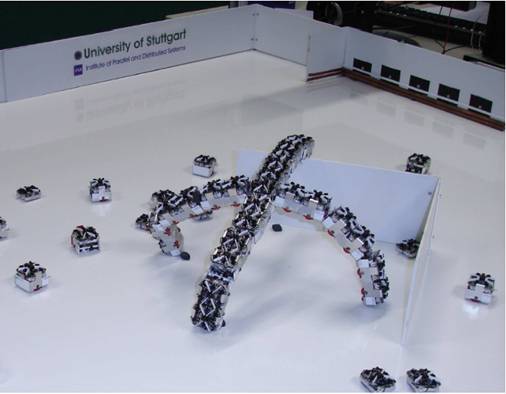
Okay, Symbrion isn't exactly building Optimus Prime quite yet. The concept involves mass-producing small robots, each roughly the size of a sugar cube. The robots would then join together to form a larger robot, a phenomenon scientists have cheerfully dubbed, "swarming." The swarm could hypothetically take the shape of anything, from a bridge to a wheel to a giant spider. Each robot in the swarm would function independently, but also be able to perform specific functions to benefit the whole.
Researchers envision deploying the robots in disaster areas, such as mine or building collapses, to look for survivors. Prof. Alan Winfield, a Symbrion researcher from the University of West England, described "Dropping hundreds of these small robots into a crevice after a building has collapsed. They would find each other and maybe connect together to form a snake-shaped object that could wriggle through the wreckage."
When joined, the robots share energy and computing power and create a more versatile organism. Each robot will be programmed with software to allow it to configure and optimize its own performance, and effectively heal itself if damaged. Winfield compared the concept to a sponge or jelly fish colony, "In a sponge, even if there is damage to some parts, the overall organism still survives."
So basically, the wet dream of every Transformers fan is finally coming to fruition. To be honest, the $9.3 million budget seems quite modest in respect to the possibilities that the project offers. It might not be artificial intelligence, but how long until a self-programming, self-adapting, self-replicating, self-healing robot becomes self aware?

Military robots have been in use for some time now, and commercial robots are gaining acceptance, but the idea of a swarm of unstoppable robotic spiders and snakes is not appealing to me.
Technology has empowered us with the ability to do amazing and once-unimaginable things, but we still need to question the practical wisdom of endeavors that displace the basic element of humanity and approach the apocalyptic science fiction of Hollywood. Hopefully, the brain trust behind Symbrion will remember that there are some tasks robots were not meant to perform.
The Symbrion project is currently recruiting Ph.D.s to conduct bioinformatics, evolutionary biology and genomics research. The project abstract, written by Prof. Paul Levi of the University of Stuttgart, Germany, is available here.
Sunday, March 02, 2008
Broad pronouncement of the week: We are entitled brats.
For immediate proof, turn on the television. Locate a reality show on Bravo or MTV. The "Real Housewives of Orange County" and their real children are halfway through a marathon of placating and whining. "The Hills" and "Newport Harbor" are stocked with people who expect to be treated with a disproportionate amount of respect, lest they erupt in a raging meltdown.
We watch these shows in horror, with a judgmental eye on their cast members, but how different are we from them? In real life, we want what we want and we want it now. No delay. No aggravation. No hassle, pain-free, our way, right away. We're a highly technical society in a land of plenty. We place a premium on efficiency and convenience. Tiny annoyances and inconveniences foul our moods and affect our behaviors. Why? And how can we get past these trivialities?
Consider this paradox: Things are becoming more instantaneous in an era when delays are rampant and increasing. There are faster flights and cars but more people in airplanes and on the roads.
What has happened, even though companies are improving service, is that "customer expectations are continuing to rise," says Roger Nunley, managing director of the Customer Care Institute in Atlanta. This can be attributed to "consumers doing business online, where they get instant gratification and quick turnarounds. That's quickly becoming the standard expectation."
Change in expectations is a generational thing, experts say. People who grew up during the Depression were happy to have a job and stuck with one for a lifetime. Many members of generations X and Y were raised in a different light. They expect a buffet of opportunities and are peeved when they don't materialize.
Narcissism and entitlement among college students have increased steadily since 1979, according to a study to be published this year in the Journal of Personality. Between that year and 2006, 16,000 college students were asked to pick between such paired statements as "I expect a great deal from other people" and "I like to do things for other people," and "I will never be satisfied until I get all that I deserve" and "I will take my satisfactions as they come."
The data are clear: The ascent of narcissism and entitlement is dramatic.
"What we really have is a culture that has increasingly emphasized feeling good about yourself and favoring the individual over the group," says the study's co-author, Jean Twenge, a professor of psychology at San Diego State University. "And that has happened across the board, culturally, and it's showing no signs of slowing down."
To complement her research, Twenge offers evidence from the field: "I have a 14-month-old daughter, and the clothing available to her has 'little princess,' or 'I'm the boss,' or 'spoiled rotten' written on it. This is what we're dressing our babies in."
Schools have programs designed to boost self-esteem. Parents say things like, "You shouldn't care what other people think of you." We're inundated with the notions of "feeling special," "believing in yourself" and "be anything you want to be." Twenge ponders all these messages in her book "Generation Me: Why Today's Young Americans Are More Confident, Assertive, Entitled -- and More Miserable Than Ever Before" (Free Press, 2006).
Quite a title, but doesn't it feel kind of right? Twenge also coins the term "iGeneration" ("i" as in both iPod and "me, me, me"), which includes those of us born in the general range of 1981 to 1999.
This goes beyond social conditioning and technology, though. Entitlement is something that's part of human narcissism. It's an ego thing that transcends generations. When something goes wrong for others, it's their fault. When something goes wrong for us, it's not ours; it's the fault of external forces. We project blame.
This projection often antagonizes a situation. Feeling entitled to something you aren't getting leads to frustration, which leads to bratty behavior and confrontation. Nearly 80 percent of Americans say rudeness -- particularly behind the wheel, on cellphones and in customer service -- should be regarded as a serious national problem, according to a study by the opinion research firm Public Agenda.
An airport is a petri dish for rude behavior: a bunch of people in close quarters under time constraints. Stress and impatience lay down the welcome mat for brattiness.
"You have people screaming at customer representatives at airports because it's snowing out -- as if they're entitled to have a sunny day," says professor W. Keith Campbell, who specializes in the study of narcissism at the University of Georgia. "That's where it gets out of hand. With entitlement, the issue is, yeah, there are certain times where we're entitled and other times we're not. The problem is when we have that meter wrong."
It's unreasonable to spend an hour on hold, in other words, but there are situations when basic entitlement turns into self-infatuation and blatant disrespect for others. All of this is tied to the feeling of not being satisfied, of thinking that some force is blocking the way to a goal we think we deserve.
"The question is, 'What the heck is enough?' " says writer and psychologist Carl Pickhardt, who specializes in parenting and child development in his private practice in Austin. "I see that all the time. A couple comes in for marriage counseling, and they ask me, 'Are we happy enough?' Somebody's at a job they like, but are they successful enough? People have to make that choice. We are a dissatisfaction market society. Advertising constantly creates the notion that whatever we have is not enough. We can declare independence of that."
But how? It's about realigning our expectations and then squelching the nagging voice in our minds that propels our discontent. Pennsylvania psychologist Pauline Wallin calls this voice our "inner brat," which is an evil twin to our "inner child." After years of counseling clients who routinely made mountains out of molehills, Wallin dived into the concept, named it and produced the book "Taming Your Inner Brat: A Guide for Transforming Self-Defeating Behavior" (Wildcat Canyon Press, 2004).
"We have enough big things to be upset about, and people are losing their minds over small things," she says. "Frustration leads to aggression. If you don't let yourself get frustrated in the first place, then you don't get so angry and you don't blow things out of proportion."
Stress also fuels bratty behavior. It makes us impatient and irritable from the get-go. Psychologist Ronald Nathan of Albany, N.Y., recommends practicing relaxation techniques when waiting for such things as the Metro, the doctor or tech support. This turns a disadvantage (the frustration of waiting) into an advantage (making good use of that time to relax).
"Whether you are tempted to interrupt someone or are trying to get around a slow car -- when you're under stress you tend to react rather than respond," says Nathan, who specializes in stress. "Look at what you're telling yourself about your world and how you are interpreting it. We sometimes interpret the world as a set of 'shoulds,' 'oughts,' 'have to's,' 'musts,' 'deserves.' Those are exaggerations. It's a very competitive world we live in, so we easily get frustrated."
Nathan has trademarked a technique for stress relief that has a time-release formula. It involves setting some kind of unobtrusive alarm -- the vibrate function on your cellphone, for example -- to remind you to take several minutes to do some deep belly breathing and loosen your muscles and limbs. After several months of conditioning yourself to do this at certain times of the day, this kind of reframing of the mind can become automatic.
Another habit to form is being grateful. Clinical experiments show that people who express gratitude in some form every day live more-content lives, and they record lower levels of narcissism and entitlement.
"On the drive home from work, it's a matter of turning the radio off and thinking about how wonderful your job is or, if your job sucks, how wonderful your family is or, if your family's in shambles, how good your health is," says psychology professor Mike McCullough, who studies gratitude at the University of Miami.
He helped conduct one experiment titled "Counting Blessings Versus Burdens," wherein one group kept a journal of their daily hassles for a period of time while another recorded the times they were grateful. The outcome may be obvious, but it is no less instructive: People who concentrated on hassles were generally miserable; the others were pleased and satisfied.
It comes down to perspective and expectations. Do you want empty highways, no lines, a promotion and limousine conveyance to your birthday party? Fine. But don't expect them. Focus on your reliable car, your good health, your job stability or the fact that you're in a position to celebrate a birthday at all.
"When you're feeling this sense of deprivation or entitlement, try to take the longer view," McCullough urges. "Ask yourself, 'Is it really true -- empirically true -- that you are entitled to something?' In most cases, people say no."
Friday, January 11, 2008
In searching for the best music of 2007, I reviewed the picks provided by Billboard, Spin, Rolling Stone, MetaCritic, Variety, CNet, NPR, Amazon, and several national newspapers. The verdict? I didn't like anything on any of their lists. So who's picking this stuff? Cambodian refugees? Gitmo detainees? The homeless? I like to think I know a few things about music; that I know a hip beat when I smell it.
Everyone likes to be unique (read: cool) with their music choices. Recommend good music to someone who's never heard it and they'll suddenly perceive you as a sophisticated person with refined cultural tastes; as if you've opened for them some metaphysical door to the possibility of new experiences. Those in positions of persuasion become mad with influence (because they work for Spin or RS), and start recommending overly-eclectic music (read: garbage), simply to demonstrate that they have access to it. They've heard what you haven't.
"Oooh, it's so metaphorically postmodern-deconstructionist because it doesn't even sound like music."
Yes, and not coincidentally, nobody can stand listening to it.
I had a friend from Berkeley who listened to hip-hop artists like Cunninlynguists and Andre Nickatina. I caught a whiff of her playlist, and after she heard me listening to her bands, the snob locked me out of her musical preferences completely. Later, I overheard some jazz music and asked her about it, and she replied, "Just some random African jazz." Really? The song had no title? The band was anonymous? Jeez.
For the record, your ability to sort through piles of Indie trash does not make you "cool." It is an indicator that different parts of the country are exposed to different things. One of the drawbacks of mass production is that certain geographic areas become demographically stereotyped, resulting in a narrowing of tastes into what becomes known as "mainstream." Sometimes good art gets cut out, purely because of the costs of production, shipping or advertising. More importantly, it is important to recognize that in a greater sense, our perspectives on life are directly connected our respective locations in it.
More to the point, if you want exposure to Cunninlynguists or Andre Nickatina in Santa Fe, Phoenix, Dallas, Houston, Oklahoma City or the Bible Belt, hopefully you have an enlightened friend because you're not going to hear them on the radio. What's worse, even if you have a friend in a culture-rich city like San Francisco or New York, the atmosphere in such places tends to de-generate people into snobs who won't share their sophisticated tastes with you.
They've worked hard to gain access to informed opinions, develop a certain sophistication, and achieve an elusive, elevated social status. Now, entrusted as gatekeepers for the rest of us plebians, what do they do? They lock us out.
It's a dichotomous reverse-evolution: Those who grow rich in social and cultural knowledge, who are immersed in it, tend to denigrate and even despise the individuals that are part of it. In my opinion, the joke is on YOU, music snob, because at the heart of your aggrandized egotism is a cruel and ironic self-loathing that prevents you from getting over your own ego. Personally, I'm glad I can't relate to that.
By the way, I've got something that you MUST hear ...
Tuesday, October 16, 2007
I was at Wal-Mart today when something became very clear to me: No single location encompasses in a microcosm our consumption-based society in such a distinguished manner as Wal-Mart. Not only is it the consumer center of many a neighborhood and small town, but Wal-Mart has a social dynamic of its own, which becomes apparent if you happen to pay close enough attention. I don't know if this really counts as an epiphany, but if you're interested in what society is evolving into, you don't need to venture much further than your neighborhood Wal-Mart.
You can find both regular and organic fruits and vegetables at Wal-Mart. You can indulge in your choice of light, low-fat or fat-free carcinogenic lard. You can choose whether to purchase the small, regular or family size potato chips, or splurge and get the variety pack. You can find the name-brand Eggo waffles right next to the generic Great Value waffles, and even the packages look similar. Just like the people that work and shop at Wal-Mart, the products come in all varieties, packages, shapes and sizes, but a lot of them are basically the same.
When an individual chooses a product for consumption, it may often seem like a decision made on a whim, but there is actually a complex value-judgment process at work. The constant bombardment of advertisement, overt and filtered through the media, create a sense of need and familiarity. After watching Leggo My Eggo commercials on every morning of every day for 16 years, I now perceive Eggo waffles as the "normal and popular" choice for a standard breakfast staple and select Eggo on a regular basis, even though Great Value waffles, which are located right next to the Eggo waffles in the freezer, are comprised of basically the same ingredients and are offered at a lower price. Great Value doesn't advertise, so I'm not familiar with it and I assume nobody else is, either. The above example also translates well with name-brand and generic fruit juices, candies, potato chips and especially cereal, so don't feel limited to just waffles.
These types of modality and value judgments constantly influence our everyday decisions. Of course, I have one of those weird super self-conscious personalities that is tweaked to be keenly aware of every detail that's going on around me, or maybe I just noticed because she was directly in front of me, but as I was walking toward the front of the store with my Eggos (and a loaf of potato bread, if you're keeping score), another shopper, who happened to be female, happened to (not) subtly visually undress me as she passed by. It wasn't the full-on, Vince Vaughn, Wedding Crashers eye-fuck, but it was close.
Anyway, what I really noticed was that after her corneas caressed by person from head to toe, her glare lingered, for just an additional moment, on my shoes. Then it struck me, she was making one of those perceptual value judgments. Does this mean that my Nikes define me as a person, that somehow the swoosh on the side indicates my refined tastes, discriminating personality and financial success? Definitely not, because anyone can walk into a store and buy a pair of Nikes. But if there weren't such mechanisms in the human brain, advertising wouldn't be such a driving factor in the capitalist marketplace.
And to be honest, aren't we a shoe-obsessed society? As a child, nothing determines social status and value more concretely than outward appearance, starting from the bottom up. Anyone who has ever played pickup basketball on the playgrounds can tell you that a players skill level can easily be guessed by examining what kind of shoes he's wearing: Scrubs wear generic sneakers, and real players wear basketball-specific name brand shoes with some kind of gimmicky spring or transparent air pocket or flubber. This is a universally-accepted fact.
So people make judgments about you based on how you look and what you wear. This is nothing new, and of course, people have caught on. A variety of counterculture styles have developed in specific response to the mass-marketed cookie-cutter style palettes circulated by clothing manufacturers. The irony is that all the counterculture styles eventually become assimilated into the mainstream, allowing people to label you even more specifically, as goth, emo, metrosexual, or gay. So not only can I purchase my value-defining products at Wal-Mart, I can simultaneously receive judgment from others regarding my value, as determined by the products I buy. Thanks, Wal-Mart!
Such is the social dynamic with every publicly peacocked feather in our caps, from our jobs to our cars to our clothes to our kids and the clothes we put on our kids. And with the new generation of eco-friendly products, there's a new dimension of pretentiousness added to the madness, for not only does my solar-powered hybrid Mercedes demonstrate my superfluous disposable income, I'm also doing my part to cut fossil fuel consumption, reduce emissions, and save arctic wildlife; I'm the better-adjusted, more successful, socially-conscious and evolved human being.
And just to add another dimension of irony, isn't Wal-Mart really at the bottom of the food chain when it comes to consuming mass quantities? Members-only warehouses might be considered more exclusive, not to mention luxury department stores like Barney's, where few can really afford to shop. Others might eschew luxury items for more "down to earth" groceries, and choose a store like Trader Joe's out of some diluted notion of social conservation. But the joke is on you, because Joe the organic pot farmer doesn't exist. Trader Joe's is owned by Theo Albrecht, a German billionaire. So next time you think it's worth spending your $12 for the Sundried Tomato and Olive Bruschetta in the glass jar because the money is going to help some hippie organic farmers in a remote village in Oregon, think again. Corporations own everything. Theo's grandchildren thank you.
Perhaps the more important question is, does all of this really mean anything? And I want to warn you, the answer might very well be no, so by all means, don't feel burdened to continue reading any further. But if you really want to think about the point of buying organically-grown fruit instead of regular fruit, or buying eggs from free-range hens instead of caged hens, and you think there's really a metaphoric lesson in doing so, that somehow one group of people might be more evolved than the rest of us because they respect the hens' right to be free, then I might remind you that the eggs you're eating could have grown to be chickens, too.
Monday, September 17, 2007
For the first time in more than 30 years, the Iranian national basketball team will compete in The Olympic Games. Led by center Hamed Ehdadi's 31 points, Iran defeated Lebanon, 74-69, in the gold medal game of the FIBA Asia tournament. This is the first continental title for Iran since the inaugural games in 1960.Iran's 2008 Summer Olympic team will feature one of the tallest players in the tournament: 7-foot-5 beanpole Jaber Rouzbehani. Rouzbehani can grab the rim flat-footed, dunk on his tip-toes and has a soft shooting touch. The catch? Although he's only 21, Rouzbehani didn't begin playing basketball until he was almost 16. He's still learning the fundamentals of the game.

Rouzbehani has been training with ex-Georgetown center Wesley Wilson and Sacramento Kings forward Shareef Abdur Rahim, but it remains to be seen if he will be the first Iranian in the NBA. Besides his inexperience, there are health concerns: Jaber was born with the same pituitary disorder as Pavel Podkolzine and Yao Ming, which limits his mobility and energy. However, Rouzbehani's potential is undeniable: he averaged 12 points, 8 rebounds and 7 blocks in the FIBA 19-Under World Championship three years ago, before he started training.
Just to give you an idea of the basketball interest in Iran, most of the courts are converted indoor soccer arenas with tile, not wood, on the floor. If nine kids show up to play and there's no tenth player, everyone goes home. To be fair, the professional league in Iran has grown since the Islamic Republic has opened its doors to Western basketball players in an effort to promote interest in the sport (former University of Texas power forward Gabe Mouneke plays for Iranian Super League Champion Saba Battery). While some international teams provide passports for non-nationals to play, as Russia did this year for CSKA's American point guard Jon Holden, the national team is Persians-only, comprised of the best players from Super League teams Saba, Ahan Esfahan and Paykan Tehran.
Now the bad news: Although they dress ten players, only seven actually play, and of those only four are "true" basketball players. They had better sign an endorsement deal with GatorAde. Due to their collective lack of experience in international competition, Iran is likely to go winless throughout the tournament with an outside shot of being blown out of every game. And you can bet they'll enjoy every gut-wrenching second of it.
Iran's Olympic hopes represent what's best about basketball, and the ability of sports to cross boundaries. The team should be a great source of national pride in Iran, where medals of significance are often displayed in historical museums. Perhaps NBA Commissioner David Stern could be convinced to host some 2009 preseason games from Tehran.The Summer Olympics will begin in July of 2008.
Wednesday, September 05, 2007
Next month, the Federal Treasury will annouce that the federal budget deficit for fiscal 2007, which ends September 30, will have dropped to a mere $158 billion, give or take a few bucks.
This would mean that the deficit has been reduced by $90 billion since 2006.
Of course, this will be toasted by the White House and Treasury as a great accomplishment.
But there's a nasty secret you may not be are aware of. If you use realistic numbers rather than what has been dubbed by industry experts as " WAAP - Washington Accepted Accounting Principles" - the real federal deficit for the current fiscal year is more than 2-1/2 times the stated deficit. Its actually closer to $335 billion.
So why is this really important? Because there's been so much joyous noise about the budget emanating from Washington, despite the subprime mess and market meltdowns, which, coincidentally, doesn't bode well for future tax collections either. It looks like all of Bush's wealthy-elite buddies that received massive tax cuts for the last several years didn't reinvest the money like we all believed they would. So now my natural contrarianism compels me to bomb the buzz machine: even a first-year finance student would catch these warning indicators.
Instead, so many investors and speculators are fleeing to the supposed safe haven of federal treasury securities lately that perhaps the time has arrived to examine the budget more closely.
If a publicly traded corporation tried keeping books by the aforementioned WAAP rather than by the Generally Accepted Accounting Principles (GAAP), its auditors would be on the phone to the SEC before you could say "Sarbanes-Oxley."
But since this is the federal government, it operates a unique budget accounting system, regardless of whether the Democratic or Republican party is in the executive office. Minimizing the actual size and impact of the deficit, in effect making it look smaller than it really is, is of great advantage to the those in power, regardless of whether they utilize tax-and-spend or borrow-and-spend policies.
Using numbers from the recent update issued by the nonpartisan Congressional Budget Office, we can examine how this works. Keep in mind that this is a simplified version to keep your eyes from glazing over. You can find a more detailed version at the CBO website.
To begin with, Social Security will take in about $78 billion more in payroll and income taxes than it shells out. The Treasury takes that cash, gives the trust fund IOUs for it, and spends it. That $78 billion isn't in the stated deficit.
Next, the Treasury will fork over $108 billion of interest on the trust fund's $2.2 trillion of Treasury holdings - but will give the trust fund IOUs, not cash. They won't count in the deficit either. Add that $186 billion to the stated budget deficit, and it more than doubles, to $344 billion.
The stated deficit, you see, measures how much less cash Uncle Sam takes in than he spends. That's fine for gauging the deficit's impact on the economy, which is what budget experts generally do. But if you're trying to assess Uncle Sam's overall fiscal condition, as the White House portends to do with its annual budget reports, you should count those IOUs in the deficit because they have to be paid someday.
Moving on, we end up with a total deficit of more than $400 billion by undoing another piece of WAAP ledger-demain: the $97 billion increase in Treasury securities held by "other government accounts," such as federal employee pension funds.
Thanks to the magic of Washington math, that doesn't increase the deficit, even though it increases the government's overall debt.
Unfortunately, there's an added layer of bad news: Congressional Budget Office Director Peter Orszag warns that at their current growth rate, Medicare and Medicaid will devour 20 percent of our gross domestic product in 2050 - more than today's entire federal budget.