Tuesday, August 14, 2007

Norah Vincent is a lesbian journalist. I say this not because “lesbian” is the only thing one might need to know about her, but to bring to mind the cliché that most lesbians, to some extent, dislike men.

From 2004-2006, Vincent went undercover disguised as a man named "Ned," in order to find out how the lives of men and women differ. She chronicled her experiences in the book, A Self-Made Man. While one could guess at most of her findings without all the effort involved in cross-dressing (incidentally, men are less vocal about emotions than women), one particular finding is especially interesting:

As “Ned” went to clubs to hang out with “his” male friends, Vincent would occasionally talk to women while still in the guise of being a man – not necessarily to hit on them, but as a means of gauging reactions to certain conversational topics when the conversation is initiated by a man.

After a few months of this, Vincent evidently began to despise women; no matter what she wanted to talk about, and no matter what her intentions were, nearly all of the women she talked to either blew her off, or were insanely rude and/or condescending to her. Without even stopping to hear what “Ned” had to say, the women in the nightclubs “Ned” visited immediately assumed he was a lecherous jerk looking only for sex, and treated him like dirt as a result.

To summarize: regular women were such assholes to a lesbian when she was dressed like a man, that she began to sympathize with men and actually dislike women. If that isn’t proof-positive that heterosexual women tend to despise and generally act like jerks to men more than men despise and generally act like jerks to women, I don’t know what is. Sexists and assholes are obviously abound in both genders, but we're talking about immediate reactions from one member of a sex to one member of another. Men may act like jerks to women, but they usually don't tend to do it just because a woman wanted to talk to them.

Women tend to despise men because of all the aforementioned reasons, many of which are beyond our control. Despite the fact that we have shitty orgasms and that sex for us can be a stressful experience, our genes still perpetually, forcefully, unfairly push us along in pursuit of sex.

As a result of these things, men tend to be more desperate than women when it comes to finding a girlfriend and/or mate. Finding a woman without a boyfriend is usually a sign of pickiness or personal choice; now matter how ugly a woman might be, odds are she can still find at least one mate. However, finding a guy without a girlfriend is usually a sign of a lack of options.

Thanks to the human male’s biologically-imposed desperation and urges, women have far more choice in choosing men, and far less pressure in doing so.


Tuesday, July 31, 2007

A New Hope

"It was a no-brainer"

Sunday, July 15, 2007

TOP 10 THINGS AMERICA NEEDS:

10. Marijuana Decriminalization. A 2007 poll conducted by Zogby International indicates that a slight majority of Americans favour the abolishment of criminal penalties for minor marijuana offenses: “Forty-nine percent of respondents, including 57 percent of men, said they would support “a law in Congress that would eliminate federal penalties for the personal use of marijuana by adults and allow states to adopt their own policies on marijuana.” Only 48 percent of those polled said they oppose such a law; three percent were undecided. The poll has a margin of error of ±3 percentage points.” 1 Growing numbers are also in favour of outright legalization with 41% agreeing that “the government should treat marijuana more or less the same way it treats alcohol: it should regulate it, control it, tax it and only make it illegal for children.” 2

9. Universal Health Care. Various polls 1 2 find that Americans want significant changes to the current medical system, including guaranteed government coverage even if it means paying more: “Americans across party lines willing to make some sacrifice to insure that every American has access to health insurance. Sixty percent, including 62 percent of independents and 46 percent of Republicans, said they would be willing to pay more in taxes. Half said they would be willing to pay as much as $500 a year more.”

8. Stricter Campaign Finance Laws. A large majority (66%) of Americans support an increasing of regulations on how politicians obtain and spend money. 1 Regarding the 2000 election: “Nearly three-fourths of the voters participating in the survey said Texas Gov. George W. Bush’s $70 million fund-raising tally is ‘excessive and a sign of what’s wrong with politics today.” Similarly, 40 percent said Bush is the presumptive nominee because of “the amount of money he raised.’” 2

7. Equal Aid to Palestinians and Israelis. Increasingly dissatisfied with the mid-east peace process, Americans want more results for their high levels of aid money to Israel. “in polling conducted 2002-2003, majorities supported the US withholding or reducing its aid to Israel and the Palestinians, as a means of pressure to influence their behavior”. 1 Americans also favour increasing the levels of aid to the Palestinians contingent on acceptance of a negotiated peace proposal: “Asked in a May 2003 PIPA poll “if the Palestinians come to terms with Israel in a peace agreement, do you think the US should equalize the amount of aid it gives to Israel and to the Palestinians,” 67% indicated they would support an equalizing aid to Palestine.” and “In the same 2003 PIPA poll with a different sample, respondents were told how much aid is currently given to Palestine, and were then asked to provide their own assessment of how much aid should be given if Palestine were to make peace with Israel. The median response was to increase aid to $1 billion, more than 14 times the $70 million provided at the time. The average response indicated a willingness to increase aid to $2.37 billion (somewhat lower than the amount indicated for Israel).” The terms of peace are overwhelmingly accepted by the Palestinian population: “A total of 72.1% of Palestinians support the Taba or Oslo B Agreement between Israel and the Palestinians.” 2

6. Reducing Military Spending. When Americans were asked in a 2005 poll how they would structure the Federal budget, the answers could hardly have been more clear: “Defense spending received the deepest cut, being cut on average 31 percent — equivalent to $133.8 billion — with 65 percent of respondents cutting.” This does not indicate an unwillingness to support the troops however: “respondents particularly preserved spending for troops, including for salaries (82%), the overall number of military personnel (61%), and development of new equipment for infantry and Marines (64%). Spending relevant to fighting terrorism was also preserved, such as for intelligence (62%), troops for special operations (58%), and advanced communications systems (69%). Also preserved was spending on capabilities for conducting peacekeeping (58%), fighting insurgents or guerrillas (56%), and work on new types of high-technology missiles and bombs (55%).” 1

5. Increased Social Spending. The same poll showing American’s interest in cutting defense spending also pointed to areas where spending would increase of people had control over the economy: “The largest increases were for social spending. Spending on human capital was especially popular including education which was increased $26.8 billion (39%) and job training and employment which was up $19 billion or a remarkable 263%. Medical research was upped on average $15.5 billion (53%). Veterans benefits were raised 40 percent or $12.5 billion and housing went up 31 percent or $9.3 billion. In most cases clear majorities favored increases (education 57%, job training 67%, medical research 57%, veteran’s benefits 63%), though only 43 percent of respondents favored increases for housing.” 1

4. Acceptance of the Kyoto Protocol. By a wide majority Americans agree that the United States should participate in the Kyoto protocol: “In June 2005, PIPA simply asked “based on what you know, do you think the U.S. should or should not participate in the Kyoto agreement to reduce global warming.” A strong majority of 73% favored participation. This was up a bit from September 2004, when only 65% favored it. Only 16% in June 2005 and September 2004 opposed participation.” 1 2

3. A Diplomatic Solution with Iran. Only 20% 1 - 40% 2 of Americans support a military strike against Iran to destroy its nuclear facilities. Diplomatic action backed by sanctions is supported by about 60% of Americans: “This ABC News/Washington Post poll finds sanctions the preferred option across the political spectrum.”

2. Pulling Troops out of Iraq. Both the American citizenry and armed forces support a timetable for withdrawal from Iraq: “Most Americans support the U.S. House provision setting a timetable that calls for most U.S. troops to be out of Iraq by September 2008, said a survey released on Wednesday. According to the CBS News poll, 59 percent of those surveyed favored the provision while 37 percent opposed it.” 1 Perhaps even more telling is the strong opposition to the war from within the army itself: “An overwhelming majority of 72% of American troops serving in Iraq think the U.S. should exit the country within the next year, and more than one in four say the troops should leave immediately, a new Le Moyne College/Zogby International survey shows.” 2

1. The Impeachment of George W. Bush. Majorities of Americans think that George Bush should be impeached for one of two possible crimes: unauthorized wire-tapping of the public and/or misleading the people in to a war with Iraq. On the matter of wire-tapping: “The poll found that 52% agreed with the statement: “If President Bush wiretapped American citizens without the approval of a judge, do you agree or disagree that Congress should consider holding him accountable through impeachment.” 43% disagreed, and 6% said they didn’t know or declined to answer. The poll has a +/- 2.9% margin of error.” 1 On the issue of Iraq: “The poll found that 50% agreed with the statement: “If President Bush did not tell the truth about his reasons for going to war with Iraq, Congress should consider holding him accountable by impeaching him.” 44% disagreed, and 6% said they didn’t know or declined to answer. The poll has a +/- 3.1% margin of error.” 2

Runner Up.

Jurisdiction to the International Criminal Court. “Americans are at least twice as likely to agree as to disagree that the United States should participate in the International Criminal Court (53%-22%)” 1

Tuesday, July 03, 2007


Happy Birthday, America!
Of American Culture

Among philosophers, the question of what creates and defines culture has always been a topic of debate. Those with a good understanding of how culture develops within civilization know that defining a culture, that is, explaining its essence for members of that culture, is always, even in non-democratic societies, a democratic event. There are canonical authorities to be selected and regularly revised, debated, accepted or dismissed. There are ideas of good and evil, belonging or not belonging (the same and the different), hierarchies of value to be specified, discussed, debated and settled (or not).

Moreover, each culture defines its enemies; who stands beyond it and threatens it. For the Greeks, as chronicled by Herodotus, anyone who did not speak Greek was automatically a barbarian, an outsider to be despised and fought against. The French classicist François Hartog, in his book The Mirror of Herodotus, painstakingly illustrates how deliberately Herodotus, civilization's foremost historian, set about constructing an image of a barbarian outsider from the Scythians, more even than from the Persians. It is not coincidental that, throughout history, conquering warlords often sought to wipe out any trace of another culture's existence.

Culture, technically, belongs to institutions, priests, academies and the state. It provides definitions of patriotism, loyalty, boundaries and what might be called "belonging". It is this quasi-official culture that speaks in the name of the whole, that tries to express the general will, the general ethos and idea, that inclusively holds the official past (the founding fathers and texts, the pantheon of heroes and villains) and excludes what is foreign or different or undesirable in the past. From it come the definitions of what may or may not be said, those prohibitions and proscriptions that are necessary to any culture if it is to have authority.

It is also true that besides the mainstream or official or canonical culture there are dissenting or alternative, unorthodox, heterodox cultures that contain many anti- authoritarian strains in competition with the official culture. These can be called the counterculture, an ensemble of practices associated with outsiders - the poor, immigrants, artistic bohemians, rebels, artists. From the counterculture comes the critique of authority and attacks on what is official and orthodox.

The contemporary Arab poet Adonis has written a massive account of the relationship between orthodoxy and heterodoxy in Arabic culture and shown the constant dialectic and tension between them. No culture is understandable without some sense of this ever-present source of creative provocation from the unofficial to the official; to disregard this sense of restlessness within each culture, and to assume that there is complete homogeneity between culture and identity is to miss what is vital and fecund.

In the United States the debate about what is American has gone through many transformations and sometimes dramatic shifts. To justify Manifest Destiny, American media depicted Native Americans as evil, heathens to be tamed or destroyed. They were called "Red Men" and insofar as they had any function in the culture--and this was as true of films as of the writing of academic history--it was as a foil to the advancing course of white civilization; an enemy of justice and Christian values. Today that has changed completely. Native Americans are seen as victims, not villains, of the advance of the US into the Wild West.

There has been a change in the status of Columbus and even more dramatic reversals in the depictions of African-Americans and women. Prominent African-American author Toni Morrison noted how in classic American literature there is an obsession with whiteness, as Melville’s Moby Dick and Poe’s Arthur Gordon Pym eloquently testify. Yet she says major male, white writers of the 19th and 20th centuries, men who shaped the canon of American literature, created their works by using whiteness as a way of avoiding, curtaining and rendering invisible the African presence in the midst of society. That Toni Morrison writes her novels and criticism with such success and brilliance now underscores the extent of the change from the world of Melville and Hemingway to that of Dubois, Baldwin, Langston Hughes and Morrison herself.

Which vision is the real America, and who can lay claim to represent and define it? The question is complex and deeply interesting but cannot be settled by reducing the matter to a few clichés.

A unique perspective of the difficulties in cultural contests whose object is the definition of a civilization can be found in Arthur Schlesinger’s book, The Disuniting of America. As a mainstream historian, Schlesinger is understandably troubled by the fact that emergent and immigrant groups in the U.S. have disputed the official, unitary national fable as it used to be represented by great classical historians such as Bancroft, Henry Adams and, more recently, Richard Hofstader. The disputants want the writing of history to reflect not only a nation conceived of and ruled by patricians and landowners but one in which slaves, servants, laborers and poor immigrants played an important but as yet unacknowledged role.

The narratives of such people--silenced by the discourses of Washington, the investment banks of New York, the universities of New England and the industrial fortunes of the Midwest--have come to disrupt the slow progress and unruffled serenity of the official story. They ask purposeful questions, tell the experiences of social unfortunates and make the claims of "lesser" peoples - women, Asians and African-Americans and other minorities, sexual as well as ethnic. Will their threads not be woven into the fabric of America?

Whether one agrees or not with Schlesinger’s cri de coeur, there is no disagreeing with his underlying thesis: that the writing of history is the royal road to the definition of a country, and that the identity of a society is in large part a function of historical interpretation, which is clouded by contested claims and counterclaims.

With American history open for revision at the hands of powers unknown, is it a surprise that American culture has become as devoid of identity? Ask yourself: what does the world know of America other than excess, frivolity and exclusion? If it is best left to America to define its own culture, what will you hear, other than millions of voices--silenced?

Friday, June 22, 2007

Skita
Its official, "Skita" is the buzz word for this years NBA draft. As in, who will be the next 'Skita:' an unknown international player with undeniable talent and raw skills but no experience, who looks incredible in workouts and is subsequently drafted high in the first round but goes on to suffer a brief and forgettable career.

From Nikoloz Tskitishvili's Wikipedia page: Tskitishvili is widely considered to be a major draft bust.

ESPN Sports writer Bill Simmons claimed that Tskitishvili is "the worst-case scenario for any foreign pick" in the NBA.

Sports Illustrated's Ian Thomsen calls him, "Nikoloz Tskitishvili--a workout prodigy who doesn't know how to play.

Skita had all the tools but never quite put it all together. Although he was followed by Darko and Kwame, Skita is now, officially, the definitive draft bust.

The 2007 NBA Draft is Thursday.

EDIT (7/26): Scooped! SI just named Skita #1 on its list of all-time draft busts.

Friday, June 08, 2007

Finals Examination

Game 1 of the NBA Finals provided many an insightful inspiration. Here are a few thoughts:

ABC's requisite over-produced stock-footage intro was interesting, but noticeably lacking the 1994-95 Houston Rockets--the back-to-back championship teams. They included other teams of that era; the 1990 Detroit Pistons and Barkley's Suns from 93. Couldn't they dust off a clip of Hakeem putting the dream shake on Shaq? Inexcusable.

Of course, instead of Olajuwon, we're treated to the same old clip of Bill Walton grabbing a rebound. What is it with the NBA and Bill Walton? He must have some kind of clandestine arrangement with David Stern that requires NBA pundits to sing his praises. It's not enough that we are forced to endure Walton's inanity on ABC and ESPN, but during the broadcast, Jeff Van Gundy spent at least two full minutes describing how much he admired Walton's game and how the NBA would be a different game now, with big men utilized more as passers, if Walton had not been forced to leave the game so early due to injury. Okay, we get it: he was good. But so were Kareem, Bill Russell, Bird, Magic (among so many others) and they're not a constant presence at every NBA telecast. Jeez.

This gives me an idea: someone needs to make a movie about a group of inner-city youths who embrace an aging hippie ex-ballplayer as a role model. Similar to the 2001 film "Hardball," but with Bill Walton in the Keanu Reeves role. Bill could even keep Keanu's gambling problem. I'm calling Spike Lee right after I finish this.

One of my favorite things about the NBA Finals is the individual player introductions. I have always wondered why the TV producers bother to provide close-ups when most players stare blankly into the camera or ignore it altogether. The reason: so we can see LeBron rep the Roc-a-fella diamond during his introduction. It's called viral marketing, folks. Plus, we are treated to the spectacle known as Scot Pollard's new hairstyle, and--hey, they threw in a Melvin Ely highlight. I was not aware that one existed.

Overall, the game went as expected; the Spurs toyed with different defensive looks and never allowed Cleveland to get into a rhythm, LeBron threw up a bunch of off-balance shots, the camera's gratuitously cut to Eva Longoria, Varejao and Ginobili flopped a bunch of times, and the Spurs blew out the Cavaliers in the third quarter. The Cavs--who, by the way, looked very happy to be there--made the game interesting with a late run that included back-to-back three-point buckets by LeBron, but it was clear that San Antonio was not going to lose.

There were bright spots for Cleveland: Daniel Gibson looks like he will be a solid pro. Even if he's not a true point guard, he makes his shots and can guard opposing point guards. Plus we get to hear the announcers call him "Boobie" on television. And you have to love Anderson Varejao's energy--even though the refs refused to make a call in his favor, the kid never quit flopping. He's relentless, as if he has a personal vendetta against the floor. With flopping becoming such an art form, I would love to see an event added to All-Star weekend which features players runing past each other and finding creative ways to flop. They could have Bill Laimbeer as a judge. Wouldn't this be better than 2-ball or that awful shooting stars contest?

One thing, hopefully, is guaranteed. At some point, LeBron's 2-for-terrible performance in Game One will be vindicated by an offensive outburst the NBA has never seen. Remember, Tim Duncan was named 2003 NBA Finals MVP on the strength of his 21-point, 20-rebounds, 10-assists, six-block performance in Game Six. Don't you think LeBron can top that? If he can't then it appears as though Cleveland is doomed, and Duncan will have another NBA Finals MVP trophy soon enough.

Wednesday, May 30, 2007

Kobe Needs A Hug


Kobe Bryant revealed to Philadelphia sports pundit Steven Smith on Wednesday morning that he wants out of L.A.

"I want to be traded," Bryant said bluntly.
Three hours later, on ESPN'S Dan Patrick Show, Kobe softened those comments, specifically focusing his displeasure toward the Lakers' front office and saying that he would be amicable to working things out if former GM Jerry West were to return.

Finally, in an afternoon interview with LAC radio, Kobe backpedaled completely, saying that, after an emotional discussion with Lakers Coach Phil Jackson, he did not want to leave L.A., and as a lifelong Laker fan, they were "his team."

So why the mixed signals? Maybe this is just a publicity stunt to gain leverage; to gauge his value and let management know that he's the one running the Lakers.

Kobe's frustration is rooted in the Lakers' first-round playoff exit and slim prospects for the upcoming season, but the firestorm was set off by the L.A. Times report quoting an anonymous source with Lakers stating that Kobe had forced Shaquille O'Neal out of LakerLand two seasons ago. And the rumors begin anew.

Basically, Kobe is a lot like my girlfriend. Things might not be perfect at home, and she could definitely leave me to find a better man, but she manages to overlook my flaws because she loves me and knows we have a future together. It's only once I start drinking and running my mouth that people start talking behind her back and the questions begin to come up: Have you been telling me the truth? Where is this relationship going? I thought you loved me!


And that's exactly what happened. After Shaq was traded to Miami, Kobe could have signed with the Clippers, but he beleived that Lakers owner Jerry Buss and GM Mitch Kupchack had a blueprint to be competitive in the immediate future. Instead, Kobe gets very little help from his team mates and the Lakers don't advance as far in the playoffs as in the previous year. So, at the pivotal moment when the Lakers organization can show that they're commited to building a winning team, what happens? The team's owner is busted for DUI and sources in the front office are talking smack about you.

And now? The marriage might be over. The ticking time-bomb has gone off, and the shockwaves were felt across the NBA, as every GM and analyst and sportswriter and blogger available offered their favorite Kobe trade scenario, no matter how atrocious. Of course, as in all good marriages, cooler heads will prevail.

Kobe will not be traded.

Jerry Buss has already committed to building around him, his coach begged him to stay, and while he's reviled in most cities, L.A. (consider the influence of this city; this is Hollywood) loves him unconditionally. Kobe's talent, experience and desire make him appealing to every GM, but his autonomy in dictating his own future limits the trade possibilities. By moving anywhere else, Bryant would relinquish the glamour of Tinseltown, and more importantly, his legacy as a Laker.


Undoubtedly, Wednesday afternoon was an interesting one. The buzz and unbridled conjecture in NBA circles was testament to Bryant's elite status as the NBA's most potent offensive threat. Alas, all of the the speculation was just ripples in the ocean--caused by the splashing of the league's most enigmatic and polarizing personality. Someone give that man a hug.

Thursday, March 29, 2007

Most Vexing Possibilities

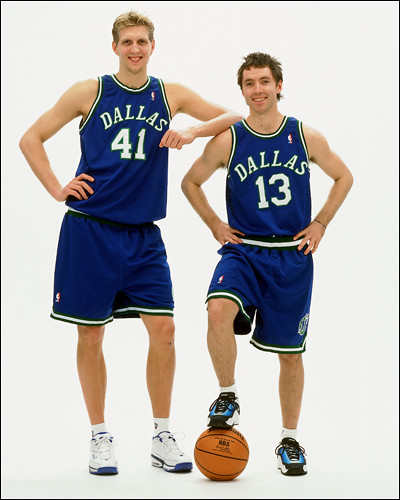
For any sports fan, there may not be any question more tantalyzing or agonizing than "What if?" As an admitted homer of the Dallas Mavericks, I can testify to our storied tradition of what ifs: What if Dale Ellis, Sam Perkins or Detlef Schrempf had spent their careers with the Mavs? What if Jimmy Jackson and Jason Kidd had never met Toni Braxton? What if Roy Tarpley could have just said no? Finally, perhaps the most torturous what if of all: What if Steve Nash had re-signed with the Mavs?

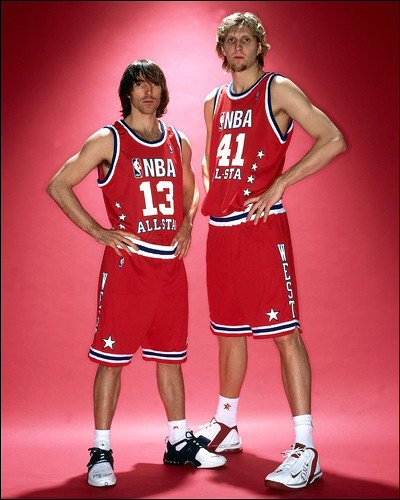
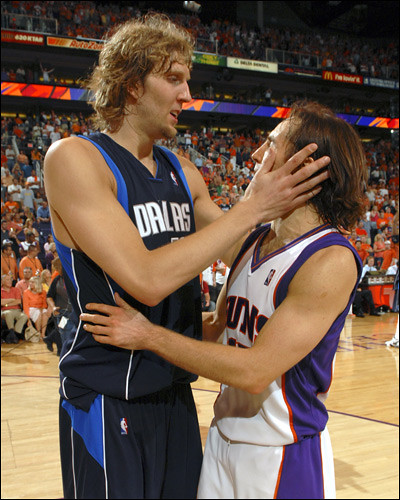
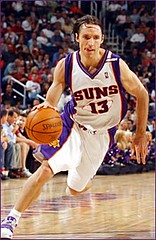
Nash, you might remember, came to Dallas from Phoenix Suns with Michael Finley as part of the Jason Kidd trade. Along with Dirk Nowitzki, Nash and Finley formed the Mavs' "big three," the franchise cornerstones who led the team back to the playoffs after a decade of irrelevance. It was in Dallas, as a Maverick, where Nash's talents and abilities began to gather acclaim. Each player utilized a unique skill set, which, when combined in Don Nelson's clever offensive schemes, was nigh unstoppable. Bringing to the game a chemistry rooted in a strong off-court friendship, Nash and Nowitzki comprised a versatile and potent offensive one-two punch. They represented Dallas at three All-Star games, but it stands as a testament to their individual talents that they accomplished so much more separately than they did together.

After the 2004 season, Nash's contract expired, and the conference-rival Suns signed him to a lucrative offer sheet. Mavericks owner Mark Cuban declined to match the offer, and the rest is history. Nash went on to win two consecutive MVP awards running the league's most explosive offense. Although his $10 million salary is gaudy, it is far below the league maximum which an MVP winner might command, and it now seems ironic that Cuban didn't deem Nash to be worth the investment.

To be fair, the primary reason that Cuban could not afford to re-sign Nash was the outstanding talent of Nowitzki, who himself commands a max contract. Without Nash, Nowitzki has blossomed into an MVP candidate and perhaps one of the NBA's greatest players. After leading the Mavericks to the NBA finals last season, Nowitzki has them knocking at the doorstep once again, with a league-best 61 wins and counting. The key to Nowitzki's emergence as a MVP-worthy clutch performer might well have been Nash's departure, which allowed Nowitzki to take over as the team's leader and go-to guy.

Nash has benefitted from the divorce as well. The Suns' team was perfectly suited to his run-and-gun style, and with the NBA altering its rules to encourage a faster pace of gameplay, Nash was enabled to maximize his talents. The result has been Nash's ascent to the ranks of the game's all-time great guards. To put his success into perspective, since the introduction of the MVP award in 1962, only five guards in NBA history have recieved the honor: Bob Cousy, Oscar Robertson, Magic Johnson, Michael Jordan and Nash. Of those five, only three have been repeat winners: Johnson, Jordan and Nash. Not a bad menage-a-trois in which to be included.

Of course, the Nash/Nowitzki debate is only magnified by the fact that they are, respectively, the leaders of the league's two best teams, with each is receiving MVP consideration this season. Dirk's supporters allege that he deserved the award last year in leading the Mavs to their first-ever finals appearance. Nash's groupies are quick to point out that he is enjoying the best statistical season of his career and arguably deserves MVP this year more than seasons past. Nowitzki proponents would counter that his Mavs are not only in sole possession of the league's best record, they are on track to win more than 65 games, putting the Mavs in the discussion of the all-time great teams in NBA history, alongside the 1977 Lakers and 1996 Bulls. It is not an easy debate in which to choose sides, although the fact that Nash has already won two MVPs seems to preclude him from coming out on top again this year.

The real question is, for those Mavericks fans who choose to consider the possibility, what if Nash had never left the Mavs? Would it have been possible to acquire the supporting pieces to complement Nash and Nowitzki? Would either player have developed into the MVP candidates they are today? Could the duo have lead the Mavs to a title? Could they have been on the level of other famous all-time great tandems such as Magic and Kareem, Jordan and Pippen, Stockton and Malone or Shaq and Kobe? Could they have been one of the most versatile and indefensible combinations in NBA history, even if for a short while? Those questions will remain forever unanswered, leaving perplexed fans with only what ifs.

Thursday, March 15, 2007

Put Your Best Face Forward

In 1961, Dr. Seuss published a story entitled, "The Sneetches," which parlayed notions of self-concept into a language that kids could understand:


Now, the Star-Belly Sneetches had bellies with stars,
The Plain-Belly Sneetches had none upon thars.
Those stars weren't so big. They were really so small
You might think such a thing wouldn't matter at all.
But, because they had stars, all the Star-Belly Sneetches
Would brag, "We're the best kind of Sneetch on the beaches."
With their snoots in the air, they would sniff and they'd snort
"We'll have nothing to do with the Plain-Belly sort!"

Despite the whimsical nature of the book, it holds a dark truth: The values of American Pop culture place a prevalent emphasis on beauty, to the extent where individuals with attractive and desirable features are given an elevated status within society. Let's name this phenomenon "Aphrodite's Law," after the fabled Greek goddess of beauty, and assume that it is always in effect. In a Darwinian sense, having attractive attributes is an advantage in natural selection. In common human interactions, our favoritism is usually somewhat obvious. Whether choosing a mate, securing employment or simply gaining entry to an exclusive nightclub, beautiful people are given priority, as if all of society shares an unspoken understanding of their eminence.


However, while we gawk at celebrities on the red carpet or check out the hottie that just walked by, our ill-conceived values produce an undesirable void. The void between reality and our perception of the ideal, between what he have attained and what we desire, is so great that it cannot be resolved. Our favoritism toward the most excellent and alluring and rare has become so ingrained in our minds that it plays a part, however subliminally, in nearly every decision we make. It might be most prevalent when you choose a date, but it is also present when you choose what products to buy, what to eat, and what recreational activities to pursue. So you might say that Aphrodite has a secret, that we pay a price--the alms for worshipping at her temple.

The value system which adulates beauty is continually reinforced by the imagery in our environment. Advertising and marketing habitually re-invent the aesthetic standard for human appearance in order to create and sell new products. Some well-conditioned consumers will conform to social trends regardless of practicality or necessity. In extreme cases fueled by insecurity, unattainable ideals of personal beauty can become an obsession. However, as philospher David Hume stated so eloquently in his 1757 essay, The Standard of Taste, "Beauty is no quality in the things themselves: It exists merely in the mind which contemplates them; and each mind perceives a different beauty." So maybe Aphrodite has two secrets, then.

The truth is, the focus of that obsession--the ideal which has been unattainable--might no longer be so out of reach. The great equalizer in the gap between groundling and graceful is technology. Medical science currently allows an unprecedented degree of control over physical imperfections and preferences. However, each cutting-edge breakthrough procedure is inexorably interconnected with an equally neoteric set of possible issues that must be considered. The one task for which technology cannot yet be relied upon is ethical decision making based on a rational perspective.

Human alteration of physical appearance is not new. Dating back to ancient cultures, most societies on most continents have incorporated some type of scarification, body ornaments or tattoos that signify social status, virility or fertility and spirituality.

"Certain physical attributes insinuate personality traits or characteristics," says Dr. Navin K. Singh, assistant professor of plastic surgery at
Johns Hopkins University. "In primitive times, emphasizing those attributes which were favorable was an effective way of attracting a mate."

Singh and other members of the Harvard Club agree that the advanced technological age has introduced a new dimension to many aspects of the medical profession. At the annual meeting of the Harvard Club of San Diego, members of the local medical community discussed the new generation of issues related to aesthetic surgery. "Cosmetic surgery has become more mainstream and more common because of increased media exposure and less invasive and less costly procedures," says Dr. Robert Singer of the Singer Surgery Center in La Jolla.

The panel also discussed the effect that globalization has had upon concepts of beauty.

"You see that many cultures are willing to transform their ethnic identities to better fit with the American cultural perceptions of beauty," said Dr. Mark Mofid, a clinical instructor at the
University of California, San Diego (UCSD) School of Medicine.

Attempts to change and sculpt the human body date back as early as 800 B.C., when physicians in
India utilized fruit acid peels to remove blemishes and skin grafts for reconstructive surgery. In some cultures, certain body organs, such as the nose, drew respect and were often augmented in various ways.

Those procedures may have been primitive compared to the technology that aesthetic surgeons use today, but the concept of using surgery for cosmetic self-improvement remains unchanged. In 2006, almost 16 million cosmetic procedures were performed worldwide, a 500% increase from 1997, according to Singer. Of that 16 million, approximately 20% of the procedures were surgical, the most common being lipoplasty. Ninety percent of patients were female in 2006, with breast augmentation as their transformation of choice. The most popular cosmetic procedure among men was penile enlargement. The most commonly performed non-surgical procedures included Botox treatments and soft-tissue fillers, such as Restylane and collagen injections.

A large part of the global boom in cosmetic surgery can be attributed to Asian nations, specifically
Japan. According to Mofid, the popular Japanese "double eyelid" procedure comprises 30% of the total cosmetic procedures in Asia. Even in the United States, Asian Americans form the largest percentage of cosmetic surgery patients among ethnic groups. The panel considered the boom to be the result of a realistically competitive world.

"Studies have shown that more attractive people often get better jobs and higher salaries," Singer says. "Society puts a huge emphasis on youth and creates standards that are unattainable by most."

The increase in procedures has led to an increase in concerns, ranging from safety to physician qualification to patient expectations. As plastic surgery has gone mainstream, misconceptions have been created regarding the risks and rewards involved.

"Extreme make-over television shows like 'The Swan' give a false impression of the experience of having cosmetic surgery," Singer says. "They may provide some information, but they trivialize the process. They don't show patient selection, the healing process or any of the problems related to having surgery. Plastic surgery is one small part of these shows; they are entertainment, not reality."


As a result of this spread of misinformation, patient selection has become an increasingly critical issue for doctors. The patient’s mental health, concept of self-esteem and history of past surgeries are important aspects for doctors to consider. More often, aesthetic surgeons are screening patients who focus on minute imperfections and routinely request cosmetic procedures. This phenomenon has become known as Body Dysmorphic Disorder (BDD), which the panel estimates affects from one to two percent of the national population -- about five million Americans.

"These people have an exaggerated, distorted self-perception," said Dr. Eda Gorbis, assistant clinical professor at the University of California, Los Angeles (UCLA) School of Medicine and an expert in plastic surgery addiction. "This is an illness of self-concept that is rooted in the mind and cannot be repaired externally."

The Diagnosis Criteria for Mental Disorders (DSM-IV), published by the American Psychiatric Association lists BDD as a somatoform disorder: a psychological conflict that presents itself through various physical conditions. In most cases, the patient’s belief in the problem is so deeply entrenched that he or she repeatedly expresses unhappiness, despite a lack of any diagnostic evidence of illness. To help treat BDD, Gorbis developed a therapy method using crooked mirrors to help patients externalize their problems by gazing at their distorted reflections.

"I have seen people who have had 50 or up to 100 different cosmetic procedures because they have not been correctly diagnosed," Gorbis says. "No ethical plastic surgeon accepts every patient. The issue of self-esteem has to be dealt with from the perspective of the values that we have."


For anyone considering plastic surgery, choosing a qualified doctor may be the most important decision. There are no federal regulations regarding plastic surgery, and most states offer little to no regulation. A physician or surgeon's license allows the bearer to choose his or her own title, including "cosmetic surgeon." In some states, such as California, the law stipulates that all plastic surgeons must be board certified, but no particular board is specified. This technicality allows internists, dentists or gynecologists to present themselves as cosmetic surgeons.

The American Board of Plastic Surgery, which according to Singer currently provides the most thorough oversight of issues related to the field, helps designate competent surgeons through a lengthy qualification process. Potential candidates must perform an additional two to three years of plastic surgery residency. Finalists must ace a written and oral examination that evaluates judgment, selectivity, ethics and the avoidance and management of complications that may arise during and after surgery. Patients can confirm physician certification by visiting www.abplsurg.org.

"The Board helps maintain high standards for plastic surgeons and really encourages a culture of safety," Singer said.

New technology is quickly expanding the frontier of plastic surgery. Doctors have discovered that surgical operations performed in-utero leave no scar tissue, which opens the possibility for scar-free cleft-palate procedures on unborn babies. Singer also alluded to better, more permanent soft-tissue fillers, better skin care through biochemical cellular aging treatments, and new frontiers for reconstructive surgery through stem cell research.

In November of 2005, French surgeons led by professors Bernard Devauchelle and Jean Michel Dubernard performed the world's first face transplant. The procedure, which took place in Amiens, France, utilized tissue, muscle, arteries and veins taken from a brain-dead organ donor to reconstruct the face of a woman who lost her nose, lips and chin in a dog attack. The 38-year-old patient, who chose to remain anonymous, underwent extensive psychological counseling prior to the operation to prepare her for the psychological impact of having an unfamiliar reflection. After a one-year recovery period, the woman is reported to be living normally, with her face essentially a hybrid of her former visage and the features of the donor.

The Harvard Club panel agreed that the procedure marks an important milestone in the evolution of aesthetic surgery, not only for the innovation of the procedure itself, but also for the ethical concerns involved. In the future, the face transplant of 2005 may come to define the transition of one generation of medical procedures to the next. The panel remains cautiously optimistic.

"One patient is not enough to evaluate the effects of a medical procedure over the long term. It is not clear whether an individual could be left worse off in the event that a face transplant failed," Singer says. "The procedure is certainly a breakthrough in facial reconstruction, however I don't think we've reached the final frontier of aesthetic surgery; the final chapter has not been written."


The rapidly-advancing technological revolution has made available a type of reality only dreamed of in science fiction. The medical profession teeters at the edge of a great and boundless frontier, one which will usher in a new generation of never-before-seen procedures. Consumers will have unparalled choice and control over every detail of their appearance, as well of the appearance of their offspring. However, health should never be sacrificed for the sake of vanity. Aphrodite's supernatural beauty was legendary, but beauty, by the laws of nature, is a temporary state of grace. Just as the fables of Aphrodite have been forgotten, all of nature's breathtaking delights are destined to fade away. What remains, in defiance of time, are the virtues of good character which we choose to live by: honor, integrity, discipline, love. In this new technological age, the most essential element of the paradigm--at the nucleus--is something that technology cannot provide: the personal, simple, human connection of the doctor-patient relationship.

Wednesday, February 21, 2007

Shielding the Powerful

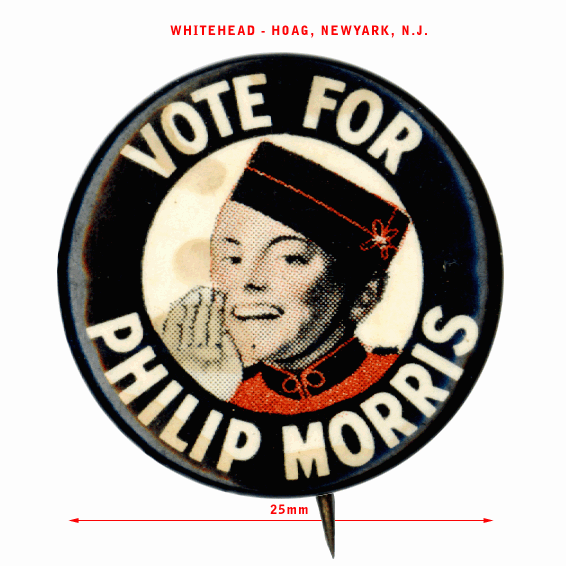
In a milestone win for corporate wrongdoers, the U.S. Supreme Court made an alarming decision yesterday to overturn the landmark $80 million punitive damage award against Philip Morris. The ruling effectively stretches the Constitution’s guarantee of due process in a way that will make it easier for companies that act reprehensibly to sidestep serious punishments. It also provides unsettling new evidence that the court is more concerned about — and more willing to protect — the powerful, as opposed to the powerless.

In 1999, an Oregon jury awarded Mayola Williams, the widow of cigarette smoker Jesse Williams, about $821,000 in compensatory damages and $79.5 million in punitive damages. Ms. Williams argued that Philip Morris had spent 40 years denying the connection between smoking and cancer, even though Phillip Morris executives knew cigarettes were deadly. The Oregon Supreme Court upheld the punitive damages award, saying that Philip Morris’s actions had been “extraordinarily reprehensible.” The ruling justices reasoned that by keeping Oregonians smoking longer than they otherwise would have, the company’s actions would, “naturally and inevitably lead to significant injury or death.”

However, by a 5-to-4 vote that did not follow the usual ideological lines, the Supreme Court ruled yesterday that the award was improper because it punished Philip Morris for harm done to people who were not part of the lawsuit. So, because the Oregon justices took into consideration the well-being of the general public, the Supreme Court overturned their ruling. There is nothing unusual, or wrong, about courts considering the broader impact of a wrongdoer’s misdeeds. As Justice John Paul Stevens noted in dissent, “A murderer who kills his victim by throwing a bomb that injures dozens of bystanders should be punished more severely than one who harms no one other than his intended victim.” The fact that Philip Morris hurt so many other smokers along with Jesse Williams is surely relevant to its punishment.

The court in recent years has become increasingly proactive when it comes to defending the rights of corporations by striking down punitive damage awards. Yesterday’s ruling continues that trend; and while the ruling did not designate such large punitive damage awards to be unconstitutional, it does expand the notion of due process and overturns the decisions of a jury and a state supreme court.

Unfortunately, the court has been far less activist when ordinary people seek protection or challenge their punishments. The ruling stands in particular contrast with the court’s 2003 decision that the Eighth Amendment’s ban on “cruel and unusual punishments” did not bar California, under its “three strikes” law, from sentencing a man to 50 years in prison for stealing $153.53 worth of videotapes. Other idiosyncratic legislation, such as the Digital Millenium Copyright Act, which imposes penalties of up to ten years in prison and fines of up to $250,000 for illegally sharing copywrighted music or video files, illustrates the influence that corporate America wields over the upper echelons of government. Yesterday’s decision is another disturbing sign that America's governing branches are not completely sovereign, and — as the current court reads the Constitution — powerful commercial parties have more rights than common citizens.

Friday, February 16, 2007

Everyone Hates Tim Hardaway

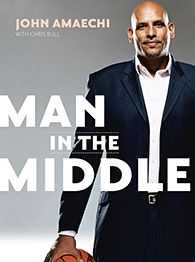
Well if you haven't heard by now, John Amaechi is out of the closet. That's right, the former power forward for the Utah Jazz and Orlando Magic is gay, and the barrage of conflicting viewpoints has commenced. It is fair to say that among the athletes, coaches and various in-the-know basketball types polled, the reactions have been tempered; any disapproval was expressed very mildly -- if at all. Then, of course, there is former Miami Heat guard and ESPN basketball analyst Tim Haradaway, who on Miami's 730 The Ticket radio last week, made his shocking revelation, "I hate gay people."

You played right into Amaechi's hands, Tim.

What's worse, he did his famous "UTEP two-step," and issued a thoroughly spurious apology through his agent. It was an ill-conceived attempt at damage control, and NBA Commissioner David Stern was not swayed. Hardaway was consequently banished from this weekend's All-Star festivities in Las Vegas, where he was scheduled to make a host of appearances on behalf of the NBA.

"It is inappropriate for him to be representing us given the disparity between his views and ours," Stern said in a statement.

Wait -- so David Stern is a gay-rights advocate? Not quite. Stern's primary interests are economic, as he wishes to ensure the continued financial prosperity of the NBA. He won't risk isolating gay fans or further polarizing players by letting such a controversial issue take a definitive face through the NBA or the opinions of its representatives. It might be fair to say that Stern is more concerned with avoiding criticism than promoting diversity. This might be the case for the majority of mainstream sports pundits as well, who are commonly verbose yet uncharacteristically reserved and benign on this particular topic.

Corporate sponorship has a way of restricting even the most expressive elements into stale banalities. The same commericalism which makes celebrities such icons also limits their ability to present themselves truthfully. While we associate certain names and faces with our favorite products, we can never be sure of those individuals' core values -- they are molded, to a certain public degree, to serve commercial interests. After all, look at what happened to Hardaway: he expressed his opinion, however vitriolic, and his own fraternity banned him from their three-day-long alumni homecoming party in Sin City. However, Hardaway serves an important purpose, because he cleared the path for a much more meaningful discussion.

The echo that triggered this dreadful "gay-in-the-NBA" avalanche is a book, Amaechi's newly-published "Man in the Middle." By all accounts, Amaechi's career was not remarkable. The only factor that lends any interest to his memoir is his sexual preference. To be specific, what everyone really wants to know is: To what degree was his homosexuality an issue? Who else knew he was gay? And once they found out, how did they react? Amaechi could have answered all of these questions by coming out while he was actually still playing in the League. At least then he could say that it was truly for a cause other than book sales.

As a gay, black Englishman in Utah, Amaechi chose to stay in the closet. In "
Man in the Middle," he does make the revelation that several current NBA players are also gay, although he doesn't name names. It is interesting to consider whether those players would have their current jobs if they were openly gay. Taking into account the negative reaction by some to Amaechi's out-coming, an openly gay athlete would risk disapproval among fans and reduced endorsement opportunities, not to mention loss of respect from teammates. Just ask The King.

"With teammates you have to be trustworthy, and if you're gay and you're not admitting that you are, then you are not trustworthy," LeBron James said in an interview with the Cleveland Plain Dealer. "So that's like the No. 1 thing as teammates - we all trust each other. We're like family and you take showers with each other. We're on the bus together and we talk about a lot of things and if you're not trustworthy, like admitting you're gay, you can't be trusted. You've heard of the in-room, locker-room code. What happens in the locker-room stays in there. It's a trust factor, honestly. A big trust factor."

While an actively homosexual team-sport athlete might become an inspirational figure from a certain perspective, coming out would undoubtedly have a negative effect on his or her playing career (with the exception, ironically, of the WNBA, where it is widely accepted that a large number of players are lesbian). Any preconceived or subconcious prejudice harbored by other players, coaches, team officials and even referees would undoubtedly cause repeated clashes. The common stereotypes of homosexuality directly contradict the macho, male-athelete stereotype. This is the true essence of James' statement. Once again, Amaechi could have smashed some of these perceptual barriers by simply coming out during his playing days.

So Amaechi is a hypocrite. But then, aren't the players, pundits and apologists who were so quick to villify Amaechi's alternative lifestyle hypocrites also? By voicing so loudly their beleifs and disapproval, aren't they embracing the same freedom of expression for which Amaechi is being criticized? Maybe moralistic homophobes hate Amaechi for being gay, but they hate him even more for announcing his preference and effectively bringing his homosexuality into the limelight. Perhaps the only thing they perceive to be more threatening than the existence of homosexuals would be mainstream America's acceptance of, or at least ambivalence to, homosexuality.

I believe this is the direction Tim Hardaway was coming from. He was upset that there had not been more vocal opposition of Amaechi's disclosure and subsequent profiteering. Hardaway exposed his bigotry by using the h-word, was supremely dishonored, and gave Amaechi opporunity to elevate himself by responding with tolerance and reason.

"Finally, someone who is honest," Amaechi said in an interview with Miami Herald columnist Dan LeBatard. "[Hardaway's statement] is ridiculous, absurd, petty, bigoted and shows a lack of empathy that is gargantuan and unfathomable. But it is honest. And it illustrates the problem better than any of the fuzzy language other people have used so far."

Ultimately, sexual preference is a private matter that is decided in the heart and mind of each individual. Amaechi's book does help raise awareness and discussion of discrimination against homosexuals, but the NBA arena is not the appropriate forum for the debate. In fact, such a polarizing issue cannot be fairly or openly deliberated, let alone neutralized, when all relevant parties have such substantial and enmeshed corporate ties -- the truth is too often obscured by commerical interests. Unfortunately for the truth, there is far too much money at stake.

Monday, January 22, 2007

Halftime Report

Only halfway through the 2006-07 NBA season, we've already seen a superstar change teams, another unneccesary melee, and the return of the new old basketball. Here are five of the first half's best:

1. Cleveland Cavaliers vs. New York Knicks (Nov. 13): In one 30-second span, Cavs forward LeBron James completed an and-one, then stole the Knicks' inbounds pass for a dunk. Following the Knicks' next possession, James grabbed the rebound, raced the length of the floor and pulled up to hit a three, then turned to Spike Lee on the sideline and proclaimed, "Ballin!" The Cavs won, 102-96.


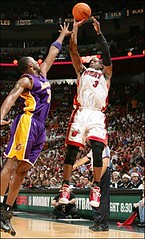
2. Miami Heat vs. LA Lakers (Dec. 15): Following the disappointing Christmas Day blowout in which Kobe Bryant only managed 16 points, we were treated to Kobe vs. Flash II for the MLK holiday. The game featured 20 lead changes, seven Lakers in double figures and an outstanding 35-8-5-4-1 stat line for Wade. In what is becoming a marquee rivalry, Bryant accepted the challenge of defending Wade down the stretch and lead the Lakers to a 124-118 victory.


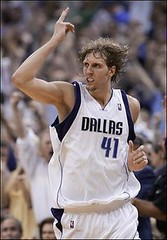
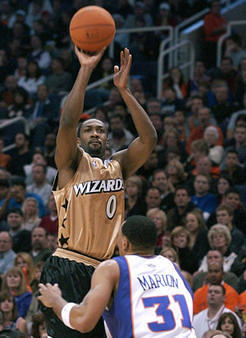
3. Dallas Mavericks vs. Phoenix Suns (Dec. 28): With five seconds remaining, Dallas' Dirk Nowizki sank an 18-foot jumpshot over Phoenix's Shawn Marion to seal the victory. Not only was the game a possible preview of the Western Conference Finals, it was a transcendent MVP performance from Nowitzki: With the game on the line, the Mavs' (and arguably the league's) best player delivered in crunch time against the opponent's best defender.


4. Cleveland Cavaliers vs. Phoenix Suns (Jan. 11): Consider this: If not for a freak 54-point performance from Gilbert Arenas and Nowitzki's aforementioned game winner, Phoenix might be in the midst of a 30-game winning streak right now. How good are the Suns? Cleveland found out the hard way, giving up 21 assists to Steve Nash in what looked like a Suns' layup drill rather than an NBA contest. Nash could have broken the all-time assist record (30 dimes dished out by Orlando's Scott Skiles), if the game hadn't been such a blowout.


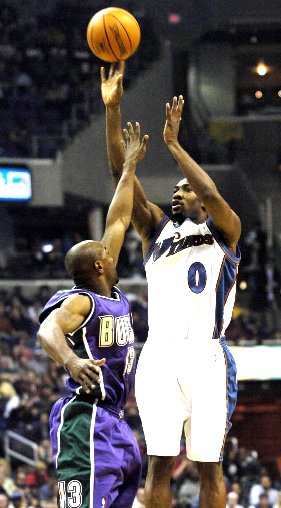
5. Utah Jazz vs. Washington Wizards (Jan. 15): After missing two infamous free throws in last year's playoff series against Cleveland, Washington's Gilbert Arenas has made this season his re-coming out party. He is currently ranked second in the league in scoring after registering 51, 54 and 60-point games this season. More importantly, his Wizards are sitting atop the Eastern Conference. After attempting the game-winning three against Utah, Arenas actually began raising his arms in celebration before the shot went in. The similar clincher he hit against Milwuakee the week before must have given him confidence.

Tuesday, December 26, 2006

Marquee Matchup: Black Mamba vs. Agent Zero

One of the more interesting sub-plots of the NBA season so far has been the inspired play of Washington Wizards virtuoso Gilbert Arenas. A do-it-all combo guard, Arenas currently ranks third in the league in scoring by averaging 30.1 points per game. To be fair, Arenas has never strugged to score -- he averaged 29.3 last season and 25.5 the season before. The suprising aspect of Arenas' awakening has been the fashion in which he's torched the competition, dropping 45 against Cleveland, 54 versus Phoenix and 60 on the Lakers. This type of scoring output would come a suprise, except that Arenas vowed to seek revenge against Team USA for being cut from the team last summer. Presumably this means its open season on everyone.

After succumbing to Arenas' 60-point barrage in overtime, Lakers guard Kobe Bryant told reporters, "He doesn't seem to have much of a conscience. I really don't think he does. Some of the shots he took tonight, you miss those, and they're just terrible shots. Awful. You make them and they're unbelievable shots. I don't get a chance to play him much, so I haven't gotten used to that mentality of just chucking it up there. He made some big ones, but I'll be ready next time."

First of all, the notion of Bryant not understanding the mentality of taking shots in bulk is ridiculous; he's the poster boy for bad shots -- he just makes them often enough that they're "okay" shots for him.
Second, Arenas made an excellent point in rebuttal, stating that Kobe wouldn't have stooped to make negative comments unless it had really gotten under his skin.

Everyone knows that Bryant is a fierce competitor blessed with elite athleticism and killer instinct. He can single-handedly take over games. Opponents fear him; last season he issed a challenge to Seattle's Ray Allen in the preseason -- incidentally, Allen missed the game. Bryant is one of the few among the NBA's elite who is a true two-way threat, potent on offense but talented enough to impact the game defensively as well. The game against Washington was no exception; after having the ball stolen by Arenas from the weak side, Bryant chased him down the court and blocked his layup attempt. He was taking the challenge personally, as all great players should. In watching Lakers games of late, it is obvious that Bryant is trying to trust his teammates more in an effort to help the team grow. However, without Lamar Odom, who is injured, the Lakers' triangle offense is stagnant, and Bryant's deference to his teammates often results in hurried possessions or turnovers. The result has been that Bryant, who is the focal point of defenses anyway, has been forced to take long jumpers or other low percentage shots.

Arenas, on the other hand, is unpredictable. He's known for giving himself nicknames like "The Black President," or "The Stealth," and yelling out "Hibachi!" when he shoots (although this has been changed to "quality shots" since Kobe's diatribe). He owns a professional video game team named Final Boss. Arenas is the guy who, after scoring 50 against Team USA Assistant Coach Mike D'Antoni's Suns, stared into the camera with a crazy look in his eye and declared "one down, one to go" -- referring to an upcoming game against the Seattle Supersonics and Nate McMillan, another Team USA assistant coach. He's basically impersonating Babe Ruth and telling you where he's going to hit the home run. Arenas is gaining a reputation for being the guy you don't want to tick off. In the Wizards free-flowing offensive attack, he has perpetual green light, and it is not uncommon for him to pull up from just inside halfcourt and launch 35-to-40-foot jumpshots. They're not necessarily bad shots either, as the Wizards uptempo style allows plenty of possessions for Caron Butler and Antawn Jamison, who combine with Arenas to form the NBA's highest-scoring trio.

The NBA currently offers more marquee matchups than at any time in league history. There are a variety of players with the multitude of skills or indomitable presence necessary to take over a game. In some cases, as with Houston's Yao Ming and Tracy McGrady, or Denver's Carmelo Anthony and Allen Iverson, a team has more than one such player. More often than not, individual rivalries overshadow the team matchup, as has become the Christmas tradition with ABC's Lakers-Heat game, obviously parlaying the Shaq-Kobe hissing match. This year however, with Shaquille O'Neal recoving from knee surgery, a new rivalry was initiated between Bryant and Miami's Dwyane Wade. In the head-to-head matchup, Wade absolutely dominated the Lakers to the tune of 40 points and 11 assists, while Bryant managed a sincere 16 in a loss.

Now, it is important to keep things in perspective. With Shaq out, Miami's offense flows almost exclusively through Wade. He is the primary ball handler and, in fact, they have few other scoring options. The Lakers, on the other hand, run the technically structured triangle offense, which requires Bryant to sacrifice shots that he could probably make. Also, Wade is the type of explosive player who can score 40 on any given night, so this was by no means a singular performance for him. Finally, Bryant, by all accounts, was suffering from the flu.

Still, perception is everything, and from a certain perspective, the Christmas Day game against Miami was a key point in Bryant's season, if not his career. It is no secret that Bryant's professional persona is an emulation of Michael Jordan. Jordan was one of his childhood idols, and Bryant received criticism for his Jordan-esque mannerisms early in his career. It is fair to say that Bryant is motivated, in a sense, to be better than Jordan, to establish his own legend outside of the imposing shadow that Jordan casts on the current generation of basketball players. Bryant wants to be the best. Now.

And he may be. This is the player who scored 81 points in a single game last season. A player who thrives in those moments in which others choke. A player who sets the league's current standard for greatness. You can be sure that, while Arenas' 60-point battery of the Lakers was nothing personal, it was motivated by Bryant's marquee status -- if you have something to prove, you must prove it against the best. But Bryant is also a player who's explosiveness has been limited by off-season knee surgery. He has seen his production decline due to Lakers' Coach Phil Jackson's emphasis on sharing the ball. With the arrival of Wade, Anthony and LeBron James and the new spokesmen of the NBA (Wade was recently named Sports Illustrated's Sportsman of the Year), Bryant has heard his name fall out of discussion.

After Arenas' offensive outburst, Kobe's remarks were the clue that revealed his frustration. The one-sided defeat against Wade -- with the entire NBA fan base watching -- might be the last straw. While Bryant and Wade were not playing one-on-one, the media's focus on marquee matchups creates a constant comparison between players that are often as similar as apples and oranges

How long will Bryant be able to squelch his ego and tolerate the short end of the stick? Jackson has stated that Jordan reached his greatest apex once he was able to trust his teammates. In chasing the game's greatest player, can Bryant adjust to playing within a system that limits his production and detracts from his personal legacy?

Perhaps the more intriguing question is, how will Bryant respond to the unspoken challenges issued by the NBA's new generation of superstars? One thing is certain, when the Lakers play the Wizards again on February 3, all eyes will be on the marquee matchup.