Wednesday, May 30, 2007

Kobe Needs A Hug


Kobe Bryant revealed to Philadelphia sports pundit Steven Smith on Wednesday morning that he wants out of L.A.

"I want to be traded," Bryant said bluntly.
Three hours later, on ESPN'S Dan Patrick Show, Kobe softened those comments, specifically focusing his displeasure toward the Lakers' front office and saying that he would be amicable to working things out if former GM Jerry West were to return.

Finally, in an afternoon interview with LAC radio, Kobe backpedaled completely, saying that, after an emotional discussion with Lakers Coach Phil Jackson, he did not want to leave L.A., and as a lifelong Laker fan, they were "his team."

So why the mixed signals? Maybe this is just a publicity stunt to gain leverage; to gauge his value and let management know that he's the one running the Lakers.

Kobe's frustration is rooted in the Lakers' first-round playoff exit and slim prospects for the upcoming season, but the firestorm was set off by the L.A. Times report quoting an anonymous source with Lakers stating that Kobe had forced Shaquille O'Neal out of LakerLand two seasons ago. And the rumors begin anew.

Basically, Kobe is a lot like my girlfriend. Things might not be perfect at home, and she could definitely leave me to find a better man, but she manages to overlook my flaws because she loves me and knows we have a future together. It's only once I start drinking and running my mouth that people start talking behind her back and the questions begin to come up: Have you been telling me the truth? Where is this relationship going? I thought you loved me!


And that's exactly what happened. After Shaq was traded to Miami, Kobe could have signed with the Clippers, but he beleived that Lakers owner Jerry Buss and GM Mitch Kupchack had a blueprint to be competitive in the immediate future. Instead, Kobe gets very little help from his team mates and the Lakers don't advance as far in the playoffs as in the previous year. So, at the pivotal moment when the Lakers organization can show that they're commited to building a winning team, what happens? The team's owner is busted for DUI and sources in the front office are talking smack about you.

And now? The marriage might be over. The ticking time-bomb has gone off, and the shockwaves were felt across the NBA, as every GM and analyst and sportswriter and blogger available offered their favorite Kobe trade scenario, no matter how atrocious. Of course, as in all good marriages, cooler heads will prevail.

Kobe will not be traded.

Jerry Buss has already committed to building around him, his coach begged him to stay, and while he's reviled in most cities, L.A. (consider the influence of this city; this is Hollywood) loves him unconditionally. Kobe's talent, experience and desire make him appealing to every GM, but his autonomy in dictating his own future limits the trade possibilities. By moving anywhere else, Bryant would relinquish the glamour of Tinseltown, and more importantly, his legacy as a Laker.


Undoubtedly, Wednesday afternoon was an interesting one. The buzz and unbridled conjecture in NBA circles was testament to Bryant's elite status as the NBA's most potent offensive threat. Alas, all of the the speculation was just ripples in the ocean--caused by the splashing of the league's most enigmatic and polarizing personality. Someone give that man a hug.

Thursday, March 29, 2007

Most Vexing Possibilities

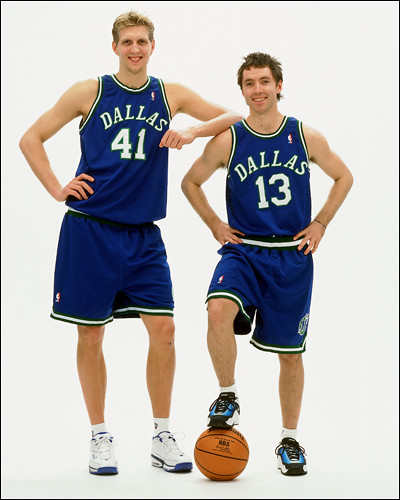
For any sports fan, there may not be any question more tantalyzing or agonizing than "What if?" As an admitted homer of the Dallas Mavericks, I can testify to our storied tradition of what ifs: What if Dale Ellis, Sam Perkins or Detlef Schrempf had spent their careers with the Mavs? What if Jimmy Jackson and Jason Kidd had never met Toni Braxton? What if Roy Tarpley could have just said no? Finally, perhaps the most torturous what if of all: What if Steve Nash had re-signed with the Mavs?

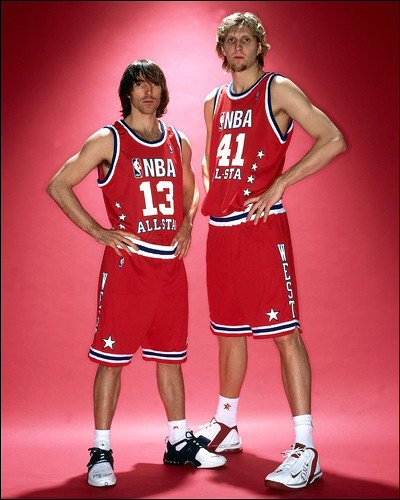
Nash, you might remember, came to Dallas from Phoenix Suns with Michael Finley as part of the Jason Kidd trade. Along with Dirk Nowitzki, Nash and Finley formed the Mavs' "big three," the franchise cornerstones who led the team back to the playoffs after a decade of irrelevance. It was in Dallas, as a Maverick, where Nash's talents and abilities began to gather acclaim. Each player utilized a unique skill set, which, when combined in Don Nelson's clever offensive schemes, was nigh unstoppable. Bringing to the game a chemistry rooted in a strong off-court friendship, Nash and Nowitzki comprised a versatile and potent offensive one-two punch. They represented Dallas at three All-Star games, but it stands as a testament to their individual talents that they accomplished so much more separately than they did together.

After the 2004 season, Nash's contract expired, and the conference-rival Suns signed him to a lucrative offer sheet. Mavericks owner Mark Cuban declined to match the offer, and the rest is history. Nash went on to win two consecutive MVP awards running the league's most explosive offense. Although his $10 million salary is gaudy, it is far below the league maximum which an MVP winner might command, and it now seems ironic that Cuban didn't deem Nash to be worth the investment.

To be fair, the primary reason that Cuban could not afford to re-sign Nash was the outstanding talent of Nowitzki, who himself commands a max contract. Without Nash, Nowitzki has blossomed into an MVP candidate and perhaps one of the NBA's greatest players. After leading the Mavericks to the NBA finals last season, Nowitzki has them knocking at the doorstep once again, with a league-best 61 wins and counting. The key to Nowitzki's emergence as a MVP-worthy clutch performer might well have been Nash's departure, which allowed Nowitzki to take over as the team's leader and go-to guy.

Nash has benefitted from the divorce as well. The Suns' team was perfectly suited to his run-and-gun style, and with the NBA altering its rules to encourage a faster pace of gameplay, Nash was enabled to maximize his talents. The result has been Nash's ascent to the ranks of the game's all-time great guards. To put his success into perspective, since the introduction of the MVP award in 1962, only five guards in NBA history have recieved the honor: Bob Cousy, Oscar Robertson, Magic Johnson, Michael Jordan and Nash. Of those five, only three have been repeat winners: Johnson, Jordan and Nash. Not a bad menage-a-trois in which to be included.

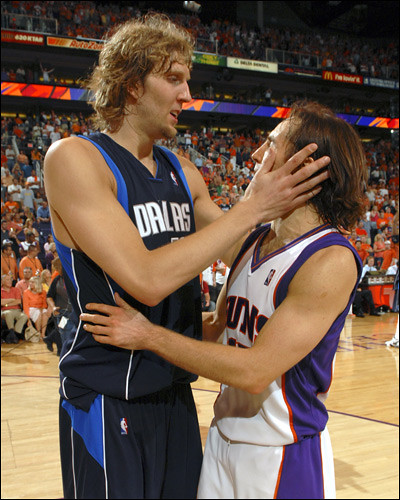
Of course, the Nash/Nowitzki debate is only magnified by the fact that they are, respectively, the leaders of the league's two best teams, with each is receiving MVP consideration this season. Dirk's supporters allege that he deserved the award last year in leading the Mavs to their first-ever finals appearance. Nash's groupies are quick to point out that he is enjoying the best statistical season of his career and arguably deserves MVP this year more than seasons past. Nowitzki proponents would counter that his Mavs are not only in sole possession of the league's best record, they are on track to win more than 65 games, putting the Mavs in the discussion of the all-time great teams in NBA history, alongside the 1977 Lakers and 1996 Bulls. It is not an easy debate in which to choose sides, although the fact that Nash has already won two MVPs seems to preclude him from coming out on top again this year.

The real question is, for those Mavericks fans who choose to consider the possibility, what if Nash had never left the Mavs? Would it have been possible to acquire the supporting pieces to complement Nash and Nowitzki? Would either player have developed into the MVP candidates they are today? Could the duo have lead the Mavs to a title? Could they have been on the level of other famous all-time great tandems such as Magic and Kareem, Jordan and Pippen, Stockton and Malone or Shaq and Kobe? Could they have been one of the most versatile and indefensible combinations in NBA history, even if for a short while? Those questions will remain forever unanswered, leaving perplexed fans with only what ifs.

Thursday, March 15, 2007

Put Your Best Face Forward

In 1961, Dr. Seuss published a story entitled, "The Sneetches," which parlayed notions of self-concept into a language that kids could understand:


Now, the Star-Belly Sneetches had bellies with stars,
The Plain-Belly Sneetches had none upon thars.
Those stars weren't so big. They were really so small
You might think such a thing wouldn't matter at all.
But, because they had stars, all the Star-Belly Sneetches
Would brag, "We're the best kind of Sneetch on the beaches."
With their snoots in the air, they would sniff and they'd snort
"We'll have nothing to do with the Plain-Belly sort!"

Despite the whimsical nature of the book, it holds a dark truth: The values of American Pop culture place a prevalent emphasis on beauty, to the extent where individuals with attractive and desirable features are given an elevated status within society. Let's name this phenomenon "Aphrodite's Law," after the fabled Greek goddess of beauty, and assume that it is always in effect. In a Darwinian sense, having attractive attributes is an advantage in natural selection. In common human interactions, our favoritism is usually somewhat obvious. Whether choosing a mate, securing employment or simply gaining entry to an exclusive nightclub, beautiful people are given priority, as if all of society shares an unspoken understanding of their eminence.


However, while we gawk at celebrities on the red carpet or check out the hottie that just walked by, our ill-conceived values produce an undesirable void. The void between reality and our perception of the ideal, between what he have attained and what we desire, is so great that it cannot be resolved. Our favoritism toward the most excellent and alluring and rare has become so ingrained in our minds that it plays a part, however subliminally, in nearly every decision we make. It might be most prevalent when you choose a date, but it is also present when you choose what products to buy, what to eat, and what recreational activities to pursue. So you might say that Aphrodite has a secret, that we pay a price--the alms for worshipping at her temple.

The value system which adulates beauty is continually reinforced by the imagery in our environment. Advertising and marketing habitually re-invent the aesthetic standard for human appearance in order to create and sell new products. Some well-conditioned consumers will conform to social trends regardless of practicality or necessity. In extreme cases fueled by insecurity, unattainable ideals of personal beauty can become an obsession. However, as philospher David Hume stated so eloquently in his 1757 essay, The Standard of Taste, "Beauty is no quality in the things themselves: It exists merely in the mind which contemplates them; and each mind perceives a different beauty." So maybe Aphrodite has two secrets, then.

The truth is, the focus of that obsession--the ideal which has been unattainable--might no longer be so out of reach. The great equalizer in the gap between groundling and graceful is technology. Medical science currently allows an unprecedented degree of control over physical imperfections and preferences. However, each cutting-edge breakthrough procedure is inexorably interconnected with an equally neoteric set of possible issues that must be considered. The one task for which technology cannot yet be relied upon is ethical decision making based on a rational perspective.

Human alteration of physical appearance is not new. Dating back to ancient cultures, most societies on most continents have incorporated some type of scarification, body ornaments or tattoos that signify social status, virility or fertility and spirituality.

"Certain physical attributes insinuate personality traits or characteristics," says Dr. Navin K. Singh, assistant professor of plastic surgery at
Johns Hopkins University. "In primitive times, emphasizing those attributes which were favorable was an effective way of attracting a mate."

Singh and other members of the Harvard Club agree that the advanced technological age has introduced a new dimension to many aspects of the medical profession. At the annual meeting of the Harvard Club of San Diego, members of the local medical community discussed the new generation of issues related to aesthetic surgery. "Cosmetic surgery has become more mainstream and more common because of increased media exposure and less invasive and less costly procedures," says Dr. Robert Singer of the Singer Surgery Center in La Jolla.

The panel also discussed the effect that globalization has had upon concepts of beauty.

"You see that many cultures are willing to transform their ethnic identities to better fit with the American cultural perceptions of beauty," said Dr. Mark Mofid, a clinical instructor at the
University of California, San Diego (UCSD) School of Medicine.

Attempts to change and sculpt the human body date back as early as 800 B.C., when physicians in
India utilized fruit acid peels to remove blemishes and skin grafts for reconstructive surgery. In some cultures, certain body organs, such as the nose, drew respect and were often augmented in various ways.

Those procedures may have been primitive compared to the technology that aesthetic surgeons use today, but the concept of using surgery for cosmetic self-improvement remains unchanged. In 2006, almost 16 million cosmetic procedures were performed worldwide, a 500% increase from 1997, according to Singer. Of that 16 million, approximately 20% of the procedures were surgical, the most common being lipoplasty. Ninety percent of patients were female in 2006, with breast augmentation as their transformation of choice. The most popular cosmetic procedure among men was penile enlargement. The most commonly performed non-surgical procedures included Botox treatments and soft-tissue fillers, such as Restylane and collagen injections.

A large part of the global boom in cosmetic surgery can be attributed to Asian nations, specifically
Japan. According to Mofid, the popular Japanese "double eyelid" procedure comprises 30% of the total cosmetic procedures in Asia. Even in the United States, Asian Americans form the largest percentage of cosmetic surgery patients among ethnic groups. The panel considered the boom to be the result of a realistically competitive world.

"Studies have shown that more attractive people often get better jobs and higher salaries," Singer says. "Society puts a huge emphasis on youth and creates standards that are unattainable by most."

The increase in procedures has led to an increase in concerns, ranging from safety to physician qualification to patient expectations. As plastic surgery has gone mainstream, misconceptions have been created regarding the risks and rewards involved.

"Extreme make-over television shows like 'The Swan' give a false impression of the experience of having cosmetic surgery," Singer says. "They may provide some information, but they trivialize the process. They don't show patient selection, the healing process or any of the problems related to having surgery. Plastic surgery is one small part of these shows; they are entertainment, not reality."


As a result of this spread of misinformation, patient selection has become an increasingly critical issue for doctors. The patient’s mental health, concept of self-esteem and history of past surgeries are important aspects for doctors to consider. More often, aesthetic surgeons are screening patients who focus on minute imperfections and routinely request cosmetic procedures. This phenomenon has become known as Body Dysmorphic Disorder (BDD), which the panel estimates affects from one to two percent of the national population -- about five million Americans.

"These people have an exaggerated, distorted self-perception," said Dr. Eda Gorbis, assistant clinical professor at the University of California, Los Angeles (UCLA) School of Medicine and an expert in plastic surgery addiction. "This is an illness of self-concept that is rooted in the mind and cannot be repaired externally."

The Diagnosis Criteria for Mental Disorders (DSM-IV), published by the American Psychiatric Association lists BDD as a somatoform disorder: a psychological conflict that presents itself through various physical conditions. In most cases, the patient’s belief in the problem is so deeply entrenched that he or she repeatedly expresses unhappiness, despite a lack of any diagnostic evidence of illness. To help treat BDD, Gorbis developed a therapy method using crooked mirrors to help patients externalize their problems by gazing at their distorted reflections.

"I have seen people who have had 50 or up to 100 different cosmetic procedures because they have not been correctly diagnosed," Gorbis says. "No ethical plastic surgeon accepts every patient. The issue of self-esteem has to be dealt with from the perspective of the values that we have."


For anyone considering plastic surgery, choosing a qualified doctor may be the most important decision. There are no federal regulations regarding plastic surgery, and most states offer little to no regulation. A physician or surgeon's license allows the bearer to choose his or her own title, including "cosmetic surgeon." In some states, such as California, the law stipulates that all plastic surgeons must be board certified, but no particular board is specified. This technicality allows internists, dentists or gynecologists to present themselves as cosmetic surgeons.

The American Board of Plastic Surgery, which according to Singer currently provides the most thorough oversight of issues related to the field, helps designate competent surgeons through a lengthy qualification process. Potential candidates must perform an additional two to three years of plastic surgery residency. Finalists must ace a written and oral examination that evaluates judgment, selectivity, ethics and the avoidance and management of complications that may arise during and after surgery. Patients can confirm physician certification by visiting www.abplsurg.org.

"The Board helps maintain high standards for plastic surgeons and really encourages a culture of safety," Singer said.

New technology is quickly expanding the frontier of plastic surgery. Doctors have discovered that surgical operations performed in-utero leave no scar tissue, which opens the possibility for scar-free cleft-palate procedures on unborn babies. Singer also alluded to better, more permanent soft-tissue fillers, better skin care through biochemical cellular aging treatments, and new frontiers for reconstructive surgery through stem cell research.

In November of 2005, French surgeons led by professors Bernard Devauchelle and Jean Michel Dubernard performed the world's first face transplant. The procedure, which took place in Amiens, France, utilized tissue, muscle, arteries and veins taken from a brain-dead organ donor to reconstruct the face of a woman who lost her nose, lips and chin in a dog attack. The 38-year-old patient, who chose to remain anonymous, underwent extensive psychological counseling prior to the operation to prepare her for the psychological impact of having an unfamiliar reflection. After a one-year recovery period, the woman is reported to be living normally, with her face essentially a hybrid of her former visage and the features of the donor.

The Harvard Club panel agreed that the procedure marks an important milestone in the evolution of aesthetic surgery, not only for the innovation of the procedure itself, but also for the ethical concerns involved. In the future, the face transplant of 2005 may come to define the transition of one generation of medical procedures to the next. The panel remains cautiously optimistic.

"One patient is not enough to evaluate the effects of a medical procedure over the long term. It is not clear whether an individual could be left worse off in the event that a face transplant failed," Singer says. "The procedure is certainly a breakthrough in facial reconstruction, however I don't think we've reached the final frontier of aesthetic surgery; the final chapter has not been written."


The rapidly-advancing technological revolution has made available a type of reality only dreamed of in science fiction. The medical profession teeters at the edge of a great and boundless frontier, one which will usher in a new generation of never-before-seen procedures. Consumers will have unparalled choice and control over every detail of their appearance, as well of the appearance of their offspring. However, health should never be sacrificed for the sake of vanity. Aphrodite's supernatural beauty was legendary, but beauty, by the laws of nature, is a temporary state of grace. Just as the fables of Aphrodite have been forgotten, all of nature's breathtaking delights are destined to fade away. What remains, in defiance of time, are the virtues of good character which we choose to live by: honor, integrity, discipline, love. In this new technological age, the most essential element of the paradigm--at the nucleus--is something that technology cannot provide: the personal, simple, human connection of the doctor-patient relationship.

Wednesday, February 21, 2007

Shielding the Powerful

In a milestone win for corporate wrongdoers, the U.S. Supreme Court made an alarming decision yesterday to overturn the landmark $80 million punitive damage award against Philip Morris. The ruling effectively stretches the Constitution’s guarantee of due process in a way that will make it easier for companies that act reprehensibly to sidestep serious punishments. It also provides unsettling new evidence that the court is more concerned about — and more willing to protect — the powerful, as opposed to the powerless.

In 1999, an Oregon jury awarded Mayola Williams, the widow of cigarette smoker Jesse Williams, about $821,000 in compensatory damages and $79.5 million in punitive damages. Ms. Williams argued that Philip Morris had spent 40 years denying the connection between smoking and cancer, even though Phillip Morris executives knew cigarettes were deadly. The Oregon Supreme Court upheld the punitive damages award, saying that Philip Morris’s actions had been “extraordinarily reprehensible.” The ruling justices reasoned that by keeping Oregonians smoking longer than they otherwise would have, the company’s actions would, “naturally and inevitably lead to significant injury or death.”

However, by a 5-to-4 vote that did not follow the usual ideological lines, the Supreme Court ruled yesterday that the award was improper because it punished Philip Morris for harm done to people who were not part of the lawsuit. So, because the Oregon justices took into consideration the well-being of the general public, the Supreme Court overturned their ruling. There is nothing unusual, or wrong, about courts considering the broader impact of a wrongdoer’s misdeeds. As Justice John Paul Stevens noted in dissent, “A murderer who kills his victim by throwing a bomb that injures dozens of bystanders should be punished more severely than one who harms no one other than his intended victim.” The fact that Philip Morris hurt so many other smokers along with Jesse Williams is surely relevant to its punishment.

The court in recent years has become increasingly proactive when it comes to defending the rights of corporations by striking down punitive damage awards. Yesterday’s ruling continues that trend; and while the ruling did not designate such large punitive damage awards to be unconstitutional, it does expand the notion of due process and overturns the decisions of a jury and a state supreme court.

Unfortunately, the court has been far less activist when ordinary people seek protection or challenge their punishments. The ruling stands in particular contrast with the court’s 2003 decision that the Eighth Amendment’s ban on “cruel and unusual punishments” did not bar California, under its “three strikes” law, from sentencing a man to 50 years in prison for stealing $153.53 worth of videotapes. Other idiosyncratic legislation, such as the Digital Millenium Copyright Act, which imposes penalties of up to ten years in prison and fines of up to $250,000 for illegally sharing copywrighted music or video files, illustrates the influence that corporate America wields over the upper echelons of government. Yesterday’s decision is another disturbing sign that America's governing branches are not completely sovereign, and — as the current court reads the Constitution — powerful commercial parties have more rights than common citizens.

Friday, February 16, 2007

Everyone Hates Tim Hardaway

Well if you haven't heard by now, John Amaechi is out of the closet. That's right, the former power forward for the Utah Jazz and Orlando Magic is gay, and the barrage of conflicting viewpoints has commenced. It is fair to say that among the athletes, coaches and various in-the-know basketball types polled, the reactions have been tempered; any disapproval was expressed very mildly -- if at all. Then, of course, there is former Miami Heat guard and ESPN basketball analyst Tim Haradaway, who on Miami's 730 The Ticket radio last week, made his shocking revelation, "I hate gay people."

You played right into Amaechi's hands, Tim.

What's worse, he did his famous "UTEP two-step," and issued a thoroughly spurious apology through his agent. It was an ill-conceived attempt at damage control, and NBA Commissioner David Stern was not swayed. Hardaway was consequently banished from this weekend's All-Star festivities in Las Vegas, where he was scheduled to make a host of appearances on behalf of the NBA.

"It is inappropriate for him to be representing us given the disparity between his views and ours," Stern said in a statement.

Wait -- so David Stern is a gay-rights advocate? Not quite. Stern's primary interests are economic, as he wishes to ensure the continued financial prosperity of the NBA. He won't risk isolating gay fans or further polarizing players by letting such a controversial issue take a definitive face through the NBA or the opinions of its representatives. It might be fair to say that Stern is more concerned with avoiding criticism than promoting diversity. This might be the case for the majority of mainstream sports pundits as well, who are commonly verbose yet uncharacteristically reserved and benign on this particular topic.

Corporate sponorship has a way of restricting even the most expressive elements into stale banalities. The same commericalism which makes celebrities such icons also limits their ability to present themselves truthfully. While we associate certain names and faces with our favorite products, we can never be sure of those individuals' core values -- they are molded, to a certain public degree, to serve commercial interests. After all, look at what happened to Hardaway: he expressed his opinion, however vitriolic, and his own fraternity banned him from their three-day-long alumni homecoming party in Sin City. However, Hardaway serves an important purpose, because he cleared the path for a much more meaningful discussion.

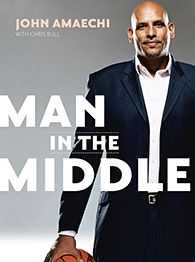
The echo that triggered this dreadful "gay-in-the-NBA" avalanche is a book, Amaechi's newly-published "Man in the Middle." By all accounts, Amaechi's career was not remarkable. The only factor that lends any interest to his memoir is his sexual preference. To be specific, what everyone really wants to know is: To what degree was his homosexuality an issue? Who else knew he was gay? And once they found out, how did they react? Amaechi could have answered all of these questions by coming out while he was actually still playing in the League. At least then he could say that it was truly for a cause other than book sales.

As a gay, black Englishman in Utah, Amaechi chose to stay in the closet. In "
Man in the Middle," he does make the revelation that several current NBA players are also gay, although he doesn't name names. It is interesting to consider whether those players would have their current jobs if they were openly gay. Taking into account the negative reaction by some to Amaechi's out-coming, an openly gay athlete would risk disapproval among fans and reduced endorsement opportunities, not to mention loss of respect from teammates. Just ask The King.

"With teammates you have to be trustworthy, and if you're gay and you're not admitting that you are, then you are not trustworthy," LeBron James said in an interview with the Cleveland Plain Dealer. "So that's like the No. 1 thing as teammates - we all trust each other. We're like family and you take showers with each other. We're on the bus together and we talk about a lot of things and if you're not trustworthy, like admitting you're gay, you can't be trusted. You've heard of the in-room, locker-room code. What happens in the locker-room stays in there. It's a trust factor, honestly. A big trust factor."

While an actively homosexual team-sport athlete might become an inspirational figure from a certain perspective, coming out would undoubtedly have a negative effect on his or her playing career (with the exception, ironically, of the WNBA, where it is widely accepted that a large number of players are lesbian). Any preconceived or subconcious prejudice harbored by other players, coaches, team officials and even referees would undoubtedly cause repeated clashes. The common stereotypes of homosexuality directly contradict the macho, male-athelete stereotype. This is the true essence of James' statement. Once again, Amaechi could have smashed some of these perceptual barriers by simply coming out during his playing days.

So Amaechi is a hypocrite. But then, aren't the players, pundits and apologists who were so quick to villify Amaechi's alternative lifestyle hypocrites also? By voicing so loudly their beleifs and disapproval, aren't they embracing the same freedom of expression for which Amaechi is being criticized? Maybe moralistic homophobes hate Amaechi for being gay, but they hate him even more for announcing his preference and effectively bringing his homosexuality into the limelight. Perhaps the only thing they perceive to be more threatening than the existence of homosexuals would be mainstream America's acceptance of, or at least ambivalence to, homosexuality.

I believe this is the direction Tim Hardaway was coming from. He was upset that there had not been more vocal opposition of Amaechi's disclosure and subsequent profiteering. Hardaway exposed his bigotry by using the h-word, was supremely dishonored, and gave Amaechi opporunity to elevate himself by responding with tolerance and reason.

"Finally, someone who is honest," Amaechi said in an interview with Miami Herald columnist Dan LeBatard. "[Hardaway's statement] is ridiculous, absurd, petty, bigoted and shows a lack of empathy that is gargantuan and unfathomable. But it is honest. And it illustrates the problem better than any of the fuzzy language other people have used so far."

Ultimately, sexual preference is a private matter that is decided in the heart and mind of each individual. Amaechi's book does help raise awareness and discussion of discrimination against homosexuals, but the NBA arena is not the appropriate forum for the debate. In fact, such a polarizing issue cannot be fairly or openly deliberated, let alone neutralized, when all relevant parties have such substantial and enmeshed corporate ties -- the truth is too often obscured by commerical interests. Unfortunately for the truth, there is far too much money at stake.

Monday, January 22, 2007

Halftime Report

Only halfway through the 2006-07 NBA season, we've already seen a superstar change teams, another unneccesary melee, and the return of the new old basketball. Here are five of the first half's best:

1. Cleveland Cavaliers vs. New York Knicks (Nov. 13): In one 30-second span, Cavs forward LeBron James completed an and-one, then stole the Knicks' inbounds pass for a dunk. Following the Knicks' next possession, James grabbed the rebound, raced the length of the floor and pulled up to hit a three, then turned to Spike Lee on the sideline and proclaimed, "Ballin!" The Cavs won, 102-96.


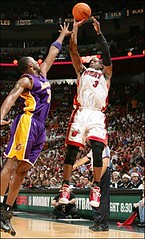
2. Miami Heat vs. LA Lakers (Dec. 15): Following the disappointing Christmas Day blowout in which Kobe Bryant only managed 16 points, we were treated to Kobe vs. Flash II for the MLK holiday. The game featured 20 lead changes, seven Lakers in double figures and an outstanding 35-8-5-4-1 stat line for Wade. In what is becoming a marquee rivalry, Bryant accepted the challenge of defending Wade down the stretch and lead the Lakers to a 124-118 victory.


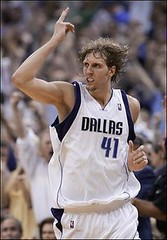
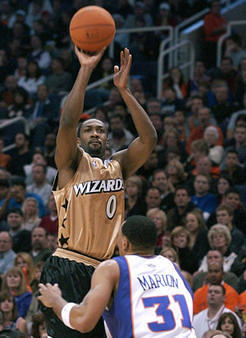
3. Dallas Mavericks vs. Phoenix Suns (Dec. 28): With five seconds remaining, Dallas' Dirk Nowizki sank an 18-foot jumpshot over Phoenix's Shawn Marion to seal the victory. Not only was the game a possible preview of the Western Conference Finals, it was a transcendent MVP performance from Nowitzki: With the game on the line, the Mavs' (and arguably the league's) best player delivered in crunch time against the opponent's best defender.


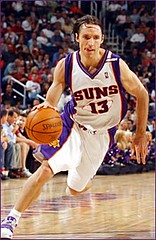
4. Cleveland Cavaliers vs. Phoenix Suns (Jan. 11): Consider this: If not for a freak 54-point performance from Gilbert Arenas and Nowitzki's aforementioned game winner, Phoenix might be in the midst of a 30-game winning streak right now. How good are the Suns? Cleveland found out the hard way, giving up 21 assists to Steve Nash in what looked like a Suns' layup drill rather than an NBA contest. Nash could have broken the all-time assist record (30 dimes dished out by Orlando's Scott Skiles), if the game hadn't been such a blowout.


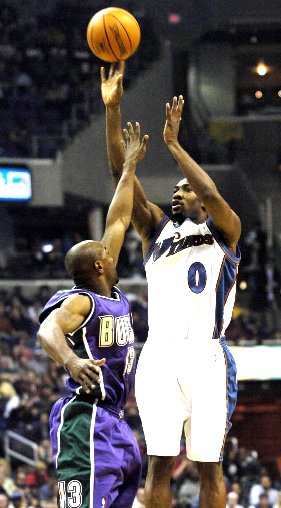
5. Utah Jazz vs. Washington Wizards (Jan. 15): After missing two infamous free throws in last year's playoff series against Cleveland, Washington's Gilbert Arenas has made this season his re-coming out party. He is currently ranked second in the league in scoring after registering 51, 54 and 60-point games this season. More importantly, his Wizards are sitting atop the Eastern Conference. After attempting the game-winning three against Utah, Arenas actually began raising his arms in celebration before the shot went in. The similar clincher he hit against Milwuakee the week before must have given him confidence.

Tuesday, December 26, 2006

Marquee Matchup: Black Mamba vs. Agent Zero

One of the more interesting sub-plots of the NBA season so far has been the inspired play of Washington Wizards virtuoso Gilbert Arenas. A do-it-all combo guard, Arenas currently ranks third in the league in scoring by averaging 30.1 points per game. To be fair, Arenas has never strugged to score -- he averaged 29.3 last season and 25.5 the season before. The suprising aspect of Arenas' awakening has been the fashion in which he's torched the competition, dropping 45 against Cleveland, 54 versus Phoenix and 60 on the Lakers. This type of scoring output would come a suprise, except that Arenas vowed to seek revenge against Team USA for being cut from the team last summer. Presumably this means its open season on everyone.

After succumbing to Arenas' 60-point barrage in overtime, Lakers guard Kobe Bryant told reporters, "He doesn't seem to have much of a conscience. I really don't think he does. Some of the shots he took tonight, you miss those, and they're just terrible shots. Awful. You make them and they're unbelievable shots. I don't get a chance to play him much, so I haven't gotten used to that mentality of just chucking it up there. He made some big ones, but I'll be ready next time."

First of all, the notion of Bryant not understanding the mentality of taking shots in bulk is ridiculous; he's the poster boy for bad shots -- he just makes them often enough that they're "okay" shots for him.
Second, Arenas made an excellent point in rebuttal, stating that Kobe wouldn't have stooped to make negative comments unless it had really gotten under his skin.

Everyone knows that Bryant is a fierce competitor blessed with elite athleticism and killer instinct. He can single-handedly take over games. Opponents fear him; last season he issed a challenge to Seattle's Ray Allen in the preseason -- incidentally, Allen missed the game. Bryant is one of the few among the NBA's elite who is a true two-way threat, potent on offense but talented enough to impact the game defensively as well. The game against Washington was no exception; after having the ball stolen by Arenas from the weak side, Bryant chased him down the court and blocked his layup attempt. He was taking the challenge personally, as all great players should. In watching Lakers games of late, it is obvious that Bryant is trying to trust his teammates more in an effort to help the team grow. However, without Lamar Odom, who is injured, the Lakers' triangle offense is stagnant, and Bryant's deference to his teammates often results in hurried possessions or turnovers. The result has been that Bryant, who is the focal point of defenses anyway, has been forced to take long jumpers or other low percentage shots.

Arenas, on the other hand, is unpredictable. He's known for giving himself nicknames like "The Black President," or "The Stealth," and yelling out "Hibachi!" when he shoots (although this has been changed to "quality shots" since Kobe's diatribe). He owns a professional video game team named Final Boss. Arenas is the guy who, after scoring 50 against Team USA Assistant Coach Mike D'Antoni's Suns, stared into the camera with a crazy look in his eye and declared "one down, one to go" -- referring to an upcoming game against the Seattle Supersonics and Nate McMillan, another Team USA assistant coach. He's basically impersonating Babe Ruth and telling you where he's going to hit the home run. Arenas is gaining a reputation for being the guy you don't want to tick off. In the Wizards free-flowing offensive attack, he has perpetual green light, and it is not uncommon for him to pull up from just inside halfcourt and launch 35-to-40-foot jumpshots. They're not necessarily bad shots either, as the Wizards uptempo style allows plenty of possessions for Caron Butler and Antawn Jamison, who combine with Arenas to form the NBA's highest-scoring trio.

The NBA currently offers more marquee matchups than at any time in league history. There are a variety of players with the multitude of skills or indomitable presence necessary to take over a game. In some cases, as with Houston's Yao Ming and Tracy McGrady, or Denver's Carmelo Anthony and Allen Iverson, a team has more than one such player. More often than not, individual rivalries overshadow the team matchup, as has become the Christmas tradition with ABC's Lakers-Heat game, obviously parlaying the Shaq-Kobe hissing match. This year however, with Shaquille O'Neal recoving from knee surgery, a new rivalry was initiated between Bryant and Miami's Dwyane Wade. In the head-to-head matchup, Wade absolutely dominated the Lakers to the tune of 40 points and 11 assists, while Bryant managed a sincere 16 in a loss.

Now, it is important to keep things in perspective. With Shaq out, Miami's offense flows almost exclusively through Wade. He is the primary ball handler and, in fact, they have few other scoring options. The Lakers, on the other hand, run the technically structured triangle offense, which requires Bryant to sacrifice shots that he could probably make. Also, Wade is the type of explosive player who can score 40 on any given night, so this was by no means a singular performance for him. Finally, Bryant, by all accounts, was suffering from the flu.

Still, perception is everything, and from a certain perspective, the Christmas Day game against Miami was a key point in Bryant's season, if not his career. It is no secret that Bryant's professional persona is an emulation of Michael Jordan. Jordan was one of his childhood idols, and Bryant received criticism for his Jordan-esque mannerisms early in his career. It is fair to say that Bryant is motivated, in a sense, to be better than Jordan, to establish his own legend outside of the imposing shadow that Jordan casts on the current generation of basketball players. Bryant wants to be the best. Now.

And he may be. This is the player who scored 81 points in a single game last season. A player who thrives in those moments in which others choke. A player who sets the league's current standard for greatness. You can be sure that, while Arenas' 60-point battery of the Lakers was nothing personal, it was motivated by Bryant's marquee status -- if you have something to prove, you must prove it against the best. But Bryant is also a player who's explosiveness has been limited by off-season knee surgery. He has seen his production decline due to Lakers' Coach Phil Jackson's emphasis on sharing the ball. With the arrival of Wade, Anthony and LeBron James and the new spokesmen of the NBA (Wade was recently named Sports Illustrated's Sportsman of the Year), Bryant has heard his name fall out of discussion.

After Arenas' offensive outburst, Kobe's remarks were the clue that revealed his frustration. The one-sided defeat against Wade -- with the entire NBA fan base watching -- might be the last straw. While Bryant and Wade were not playing one-on-one, the media's focus on marquee matchups creates a constant comparison between players that are often as similar as apples and oranges

How long will Bryant be able to squelch his ego and tolerate the short end of the stick? Jackson has stated that Jordan reached his greatest apex once he was able to trust his teammates. In chasing the game's greatest player, can Bryant adjust to playing within a system that limits his production and detracts from his personal legacy?

Perhaps the more intriguing question is, how will Bryant respond to the unspoken challenges issued by the NBA's new generation of superstars? One thing is certain, when the Lakers play the Wizards again on February 3, all eyes will be on the marquee matchup.

Sunday, November 19, 2006

Improvisational Jazz

The feel-good story of the fledgling NBA season has got to be the Utah Jazz. Thier 9-1 opening ties a team record, and with their next opponent being Toronto, the Jazz are all but guaranteed their best start in franchise history. Not bad for a team that went from a perennial contender in the West to an injury-plagued chemistry nightmare, seemingly overnight.
John Stockton and Karl Malone were the face of the Jazz for more than a decade, leading their teams to the cusp of greatness twice by reaching the finals in 1997 and 1998. Stockton and Malone so distinctively embodied the Jazz that they are enshrined in bronze outside of the Delta Center (now EnergySolutions Arena) in Salt Lake City. Their flawless pick-and-roll execution notwithstanding, Stockton and Malone's teams were eclipsed by the Chicago Bulls and the talent and indomitable will of Michael Jordan. After their franchise cornerstones retired and moved on, the Jazz were left with few assets, having recieved nothing in return for their departed superstars. Faced with rebuilding, suffering through a miserable season and having endured personal tragedy after the death of his wife, Jazz Coach Jerry Sloan, the longest-tenured coach in NBA history, considered retirement.

Nobody deserves to win more than Jerry Sloan. If victories were based on merit, Sloan would be much higher on the list of the winningest coaches of all time (he's 8th). A throwback to a different era of the NBA, Sloan was deemed by many to be too "old-school" to relate to today's young players. Somehow, Sloan and VP of Player Development Kevin O'Connor have managed to assemble a young roster that will not only listen, but will play hard and compete.
The new Jazz were built around gritty, defensive-minded role players. Small forward Andre Kirilenko, a wiry, spring-powered ball of energy, is their best shot-blocker. Post bruiser Carlos Boozer plays power forward at only 6-foot-7. Center Mehmet Okur is arguably the team's best three-point shooter. On paper, everything looks backwards, clashing like the team's new baby blue alternate uniforms. But on the court, the Jazz are a running-and-gunning, fluid basketball team that outscored the notoriously uptempo Phoenix Suns 120-117 in overtime tonight.

Its not shocking to realize how Sloan turned things around. He has always been able to maximize the performances of mediocre players, taking teams deep into the playoffs while relying the likes of Thurl Bailey, Bryon Russell, Howard Eisley, Greg Ostertag, Adam Keefe and Jarron Collins for major contributions. Kirilenko, Boozer and Okur are much better than any frontcourt tandem Utah previously offered. None of them possess the all-around skill of Karl Malone, but with AK-47, Booz and Memo on the court together, they present a host of matchup problems for most NBA teams. Not to mention that the trio average 46.4 points and 27.9 rebounds and are a major reason the Jazz are favored to win the Northwest division title. They have remarkable chemisty considering that Kirilenko and Boozer have spent more time in the training room over the past two seasons than on the court together (incidentally, Kirilenko is out again).
The Jazz are deep in the backcourt as well. Deron Williams, selected No. 3 in last years draft, has matured and improved his decision making after spending the summer training with Stockton. Matt Harpring is a determined, physical guard who's game is reminiscent of Sloan's days as a Chicago Bull. In the off-season, Utah added guard Derek Fisher, a sharpshooter who brings championship experience and veteran leadership. They also drafted two rookies: Ronnie Brewer, an athletic wingman to complement Williams' uptempo flair, and Paul Milsap, a no-nonsense frontcourt workhorse. Perhaps the biggest suprise for Utah has been the rapid development of second-year guard C.J. Miles, who played in the NBDL last season but earned a starting spot in training camp this year. Sloan, who is known for keeping young players on the pine, isn't breaking from philosophy. He's playing the youngsters in an effort to build team chemistry, establish a rotation, and help the team escape the shadow of Stockton and Malone.

Sloan's system has always been based on tough defense and the high pick-and-roll. With a capable point guard in Williams and a well-balanced frontcourt, Sloan now has a variety of options despite his rather simple offensive game plan. Even if the pick and roll isn't clicking, Williams can make clutch shots, just as he did tonight against Phoenix, hitting the jumpshot that sent the game into overtime. This newly discovered confidence, the swagger, is what has been missing in Utah since Stockton and Malone were removed from the marquee. Although the system and coach have remained the same, this team needed to find its own identity.

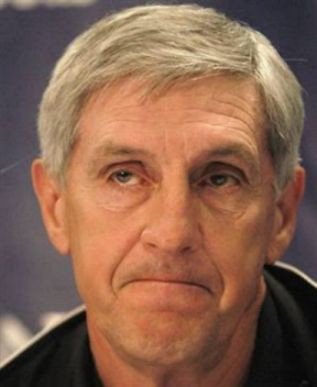
The new, young Jazz look like they're for real, and if they can stay healthy and make the playoffs, Sloan may earn the much-deserved Coach of the Year honors that have eluded him during his long career. It might just be enough to wipe that frozen scowl off his face. Then again, maybe not.

Saturday, October 14, 2006

Pungent Punditry

ESPN's resident sports satirist Bill Simmons is known for his sarcastic insight and analysis of prominent athletes. After the Dallas Cowboys recent foibles, he offered some thoughts on Drew Bledsoe and T.O. Here are his comments from ESPN.com's Page2:
"Drew Bledsoe has added a degree of difficulty for blowing big games. In the old days, he'd just throw a backbreaking interception at the worst possible time. But because everyone knows that's coming now, he added a fascinating wrinkle: An improbable play to throw us off and make us forget he's about to blow the game (like last week's fourth-and-18 bomb to Glenn), followed by the backbreaking interception that becomes doubly backbreaking because of the preceding events."
While there is truth to Simmon's barb, has Bledsoe been any more disappointing this season than Duante Culpepper, Brett Favre, Steve McNair, Ben Roethlisberger or Kurt Warner? I would consider each of the aforementioned QB's (except Big Ben) reasonably comparable to Bledsoe by age, experience and performance, but only McNair's Ravens (4-1) have a better record than the Cowboys (2-2). Lets face it, Bledsoe has never been consistent -- except that when he needs to throw the ball he holds it, and when he needs to hold it he throws a pick. However, I can't think of anyone more steadfast than Bledsoe's coach, Bill Parcells, and I believe he is still determined to get the best out of Bledsoe this season. That being said, last week's 3rd-and-goal interception by Philadelphia's Lito Sheppard made me consider moving to New Orleans and following the Saints to the Super Bowl.
"If you're broadcasting a game with Terrell Owens involved, it's important to blame him at all times for whatever bad things are happening to his team, even if his QB and secondary are the ones blowing the game. And it's imperative that the production crew shows every possible replay of T.O. yelling at someone on the bench without anyone wondering whether he's yelling because it's so deafening in the stadium that nobody can hear. Keep playing it this way until we can CGI fake footage of him punching teammates. He's clearly the Antichrist."
Okay, T.O. is a distraction, Bledsoe has A.D.D. and the secondary are narcoleptics. Blame is an easy thing to toss around. Blame Jerry Jones for paying Owens $10 million. Blame Parcells for his stoic philosophy. Blame the media for the spotlight that magnifies T.O.'s every action. It seems like simple logic: T.O. scores touchdowns; throw him the ball. Owens may not have been responsible for the Cowboys loss to Philadelphia, but he is in control of the negativity that follows him around. Nobody is manipulating T.O.'s sideline demeanor or post-game comments. Ostensibly, T.O. is unhappy because he's not being given the opportunity to help the team win. When was the last time Owens was happy about anything? For Cowboys fans, it is a hard pill to swallow coming from a guy who has repeatedly proven that he's not a team player.

Wednesday, October 11, 2006

Morbid Curiosity

A 2005 triple-homicide in Tacoma caught my interest primarily due to the arrogant contumacy of the killer. Now, more than a year later, the wheels of justice are clunking absently along, giving the accused a chance to declare himself "guilty as charged," thereby avoiding the death penalty. Some of the more interesting facts of the case are coming to light, including the dubious character of all involved players, Caesar-esque tragic irony in the form of murder delivered by a comrade, public messages exchanged on Myspace, and the comical ignorance of the so-called "mastermind."

It seems that Daniel Varo, Darren Christian and Ulysses Handy knew eachother well. Christian was a known drug dealer who befriended Handy, an ex-con. Whether Christian or Varo knew the full extent of Handy's background is unclear. However, an altercation led Handy and accomplice Sirree Mohammed to murder the two, along with Lindy Cochran (who is the definition of "being in the wrong place at the wrong time"), during the course of a robbery. Handy got caught by having the audacity to return to the crime scene.

The most fascinating aspect of this story was the Myspace ripple effect -- the exchange of messages leading up to the killings, and the sympathetic or vindictive messages left afterwards -- taking place in full view of the public. Handy himself seems like a walking contradiction, cold-blooded enough to murder his friends, foolish as to leave incriminating messages on Myspace, and insolent enough to remain remorseless.

Handy (left), with Darren Christian.

This consequential fallout of this story illustrates how portraits of people can be painted, often inaccurately, post mortem. Even if one knows and supposes nothing about these individuals, by browsing through the myriad interwoven threads the picture become less obscured -- and presents an inherent and unavoidable duality. News coverage of violent crime tends to focus on the atrocity of the crime itself, often glorifying the killer and divulging little about the victims. The Myspace ripple, in this case, reveals the victims and their ostensible social circle as money-loving, hard-partying, motorcycle-riding speed demons. The ripple, while meant to provide tribute to the victims, may result in a decreased probability of empathy from the common objective reader.

That is not to say that the victims are to blame for their own murder; Handy executed Christian and Varo without provocation for what he deemed to be a disrespect issue, and murdered Cochrane because she was a witness. However, the irony of leaving behind a visual reference of the fast-lane lifestyle that resulted in the owner's demise is too substantial to go unmentioned. The depth of information on Myspace serves a greater purpose in that it brings to light the circumstances under which these people lived and died, and may act as a deterrent to others who seek to appease their morbid curiosity by perousing those blogs.

Friday, September 29, 2006

Redefining Torture

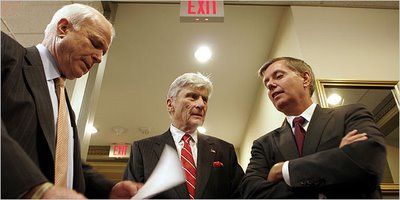
The military trials bill approved by Congress on Thursday night lends legislative support for the first time to broad rules for the detention, interrogation, prosecution and trials of terrorism suspects far different from those in the familiar American criminal justice system.

President Bush's argument that the government requires extraordinary power to respond to the unusual threat of terrorism helped him win final support for a system of military trials with highly truncated defendant's rights. The United States used similar trials on just four occasions: during the country's revolution, the Mexican-American War, the Civil War and World War II.

Included in the bill, passed by Republican majorities in the Senate yesterday and the House on Wednesday, are unique rules that bar terrorism suspects from challenging their detention or treatment through traditional habeas corpus petitions. They allow prosecutors, under certain conditions, to use evidence collected through hearsay or coercion to seek criminal convictions.

The bill rejects the right to a speedy trial and limits the traditional right to self-representation by requiring that defendants accept military defense attorneys. Panels of military officers need not reach unanimous agreement to win convictions, except in death penalty cases, and appeals must go through a second military panel before reaching a federal civilian court.

By writing into law for the first time the definition of an "unlawful enemy combatant," the bill empowers the executive branch to detain indefinitely anyone it determines to have "purposefully and materially" supported anti-U.S. hostilities. Only foreign nationals among those detainees can be tried by the military commissions, as they are known, and sentenced to decades in jail or put to death.

At the same time, the bill immunizes U.S. officials from prosecution for cruel, inhumane or degrading treatment of detainees who the military and the CIA captured before the end of last year. It gives the president a dominant but not exclusive role in setting the rules for future interrogations of terrorism suspects.

Written largely, but not completely, on the administration's terms, with passages that give executive branch officials discretion to set details or divert from its protections, the bill is meant to provide what Bush said yesterday are "the tools" needed to handle terrorism suspects U.S. officials hope to capture.
For more than 57 months after the 2001 terrorist attacks on the World Trade Center and the Pentagon, Bush maintained that he did not need congressional authorization of such tools. But the Supreme Court decided otherwise in June, declaring the administration's detainee treatment and trial procedures illegal, and ruling that Bush must first seek Congress's approval.

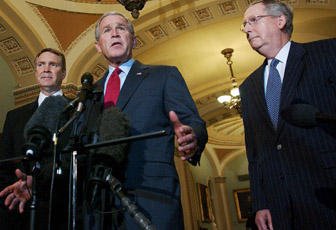
Now Bush has received much of the authority he desired from party loyalists and a handful of Democrats on Capitol Hill. "The American people need to know we're working together," Bush told senators before yesterday's vote.

But Tom Malinowski, the Washington office director for Human Rights Watch, said Bush's motivation is partly to protect his reputation by gaining congressional endorsement of controversial actions already taken. "He's been accused of authorizing criminal torture in a way that has hurt America and could come back to haunt our troops. One of his purposes is to have Congress stand with him in the dock," Malinowski said.

The bill contains some protections unavailable to the eight Nazi saboteurs who came ashore in the United States in 1942 and were captured two weeks later. Six were executed that year after a closed military trial on the fifth floor of Justice Department headquarters. That proceeding was upheld by the Supreme Court in a decision it explained two months after the electrocutions.

Under the new procedures, trials are supposed to be open, but can be closed to protect the security of individuals or information expected to harm national security. Defendants have a right to be present, unless they are disruptive, and a right to examine and respond to the evidence against them. Proof of guilt must exceed a reasonable doubt.

Many constitutional experts say, however, that the bill pushes at the edges of so much settled U.S. law that its passage will not be the last word on America's detainee policies. They predict it will shift the public debate to the federal courts, a forum where the administration has had less success getting its way on counterterrorism policies.

"This is a full-employment act for lawyers," said Deborah Perlstein, who directs the U.S. Law and Security Program at the New York-based nonprofit group Human Rights First.

Former White House associate counsel Bradford A. Berenson, a supporter of the bill and one of the authors of the rules struck down by the Supreme Court, agreed. "Some of the most creative legal minds are going to be devoted to poking holes in this," he said.

Anticipating court challenges, the administration attempted to make the bill bulletproof by including provisions that would sharply restrict judicial review and limit the application of international treaties -- signed by Washington -- that govern the rights of wartime detainees.

The bill also contains blunt assertions that it complies with U.S. treaty obligations.

University of Texas constitutional law professor Sanford V. Levinson described the bill in an Internet posting as the mark of a "banana republic." Yale Law School Dean Harold Koh said that "the image of Congress rushing to strip jurisdiction from the courts in response to a politically created emergency is really quite shocking, and it's not clear that most of the members understand what they've done."

In contrast, Douglas W. Kmiec, a professor of constitutional law at Pepperdine University, said Congress "did reasonably well in terms of fashioning a fair" set of procedures. But Kmiec and many others say they cannot predict how the Supreme Court will respond to the provision barring habeas corpus rights, which he said will leave "a large body of detainees with no conceivable basis to challenge their detentions."

There are other likely flashpoints. In the Supreme Court's June decision overturning previous administration policies, four members of the court who joined the majority opinion said conspiracy is not a war crime. The new bill says it is.

Georgetown University law professor Neal Katyal said the bill's creation of two systems of justice -- military commissions for foreign nationals and regular criminal trials for U.S. citizens -- may violate the Constitution's 14th Amendment, which requires equal protection of the laws to anyone under U.S. jurisdiction.

"If you're an American citizen, you get the Cadillac system of justice. If you're a foreigner or a green-card holder, you get this beat-up-Chevy version," he said.

On Detainee Legal Rights

The Definition of 'Unlawful Enemy Combatant'

The bill expands the definition of unlawful enemy combatants to include people who have "purposefully and materially supported hostilities" and people who have been declared enemy combatants under Combat Status Review Tribunals, "or another competent tribunal established under the authority of the President or the Secretary of Defense." Under this new language, people in the United States who are not American citizens could be declared unlawful enemy combatants and held indefinitely without trial.
Habeas Corpus

The bill prohibits detainees held by the United States from filing lawsuits challenging their detention, known as habeas corpus pleadings. This wipes out both pending and future lawsuits, and it would apply to people picked up anywhere in the world, including the United States.

The provision is significant. Habeas corpus is an ancient protection that stems from English common law, and its use dates back to as early as the 12th century. In 1969, the Supreme Court called it "the fundamental instrument for safeguarding individual freedom against arbitrary and lawless state action." Sen. Arlen Specter (R-PA) introduced an amendment to remove this part of the legislation. He argued that the ability to challenge one's detention is one of the most fundamental rights enshrined in the Constitution. The proposed amendment failed.

On the Geneva Convention

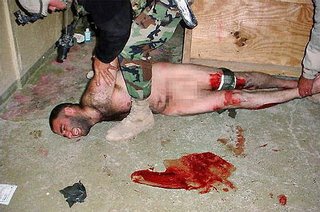
Coercive Interrogation Tactics

The bill prohibits "grave breaches" of Common Article 3 of the Geneva Conventions. That includes "cruel or inhuman treatment." But many legal analysts and government officials believe the definition of cruel or inhuman treatment as written in the bill does not encompass some of the severe interrogation tactics that the CIA has reportedly used against terrorism suspects. The bill also prohibits enemy combatants from filing lawsuits claiming a violation of their rights under the Geneva Conventions. That could make it difficult to hold accountable those who do engage in torture.

Presidential Power

The bill gives the president the power to "interpret the meaning and application of the Geneva Conventions." Critics fear this means that the president can unilaterally authorize interrogation techniques that many people would consider torture.

War Crimes Act

The legislation would narrow the range of offenses prohibited under the War Crimes Act. This would protect civilians (such as CIA interrogators and White House officials) from being prosecuted for committing acts that would have been considered war crimes under the old definition. The change is retroactive to 1997, which means any crimes committed since 1997 would be prosecuted under the new standard, not the old one.

On Military Commisions

Evidence Obtained Through Coercion

If an enemy combatant made a statement under coercion before Congress passed the Detainee Treatment Act in 2005, the evidence is admissible at a military tribunal in most cases. If the statements were made after Congress passed the 2005 ban on coercive interrogation tactics, the evidence is admissible only if a military judge finds that "the interrogation methods used to obtain the statement do not violate the cruel, unusual, or inhumane treatment or punishment prohibited by the Fifth, Eighth, and Fourteenth Amendments to the Constitution."

Secret Evidence

The first draft of this legislation said that defendants could "examine and respond" to all of the evidence against them at a military tribunal. Now it says only that defendants can "respond" to all evidence. The full implications of this phrase aren't entirely clear. Defense lawyers will likely argue that defendants can't respond to evidence they haven't been able to examine.

Hearsay Evidence

Hearsay evidence is generally acceptable at military tribunals. A judge has to rule that the evidence is reliable and relevant to the trial.

Wednesday, September 27, 2006


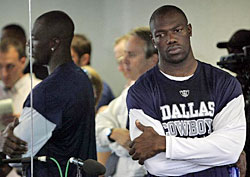
Who is the Real Terrell Owens?

Off the record, from what I've been able to gather so far today, Terrell Owens' press conference is only half of the story. For those of you just tuning in, the Cowboys' wide reciever was rushed to the hospital late Tuesday night. Early reports indiciated that he may have attempted suicide, although he later denied those rumors, stating that he suffered an adverse reaction to a mixture of pain medication and nutritional supplements, and that the police mistakenly categorized it as a suicide attempt.

The details that trickled across my desk late Wednesday may shed some light on the true nature of events. The information came from Owens' close friend and personal trainer, James "Buddy" Primm (via a third party, of course). Apparently Owens' young son (from a prior relationship) celebrated his seventh birthday this past Monday (I'm still trying to confirm this), and the two were unable to meet. The same day, Owens' current girlfriend, to whom he has been engaged for over a year, allegedly gave him an ultimatum, which my source relayed as "get married or else." According to Buddy, Owens explained that he was under too much pressure this year to take that step, and she dumped him. So Monday was not a good day for T.O.

Pressure is an interesting phenomenon. Some individuals thrive on it; others crumble under it. Pressure should be nothing new to T.O., he is in the limelight on a weekly basis and seems to embrace every minute of it. However, personal and professional pressure are two very different animals. In Owens' case, he has made life in Dallas more stressful than necessary. T.O. lives in a $400,000 loft about a block from Fair Park. While the surroundings are very posh, it's a long drive to Valley Ranch. He wakes up early to get to practice during rush-hour and spends a long day there, after which he participates in more specialized, intesive workouts with Buddy. Buddy insists that Owens' teammates have been telling him that he lives too far from work, that he should move out before the State Fair begins (Sept. 29), and that Owens has been contemplating moving into the W Hotel for a few weeks to escape the frenzy.

What is certain is that there is more to the story than meets the eye. Behind his showmanship and smiling persona, T.O. is a very emotionally dependent person. Buddy, the man who introduced Owens to the hyperbaric chamber, recently lived with T.O. until publicist Kim "25 million reasons" Etheredge took his place. (On a side note, after the press conference today, I have the feeling that Etheredge won her job after a drunken night of playing H-O-R-S-E with Owens: "Okay now T.O., if I hit this one, I get to be your publicist...") Buddy infers that Etheredge's presence is a result of the cold, corporate environment at Valley Ranch. Apparently Owens is not close with many of his teammates, and spends much of his time hanging around with second and third-string players. From a psychological angle, it almost seems like a self-esteem issue. Coach Bill Parcells is known to be unfeeling, distant and demanding -- it's hard to imagine that he provides the TLC or personal attention that Owens needs.

Unfortunately for Owens, his fastest and most vocal supporters in this case have been Michael Irvin and Deion Sanders. Maybe it's just me, but doesn't an emotionally unbalanced person need friends with a bit more moral fortitude? Regardless of the circumstances, it's hard to believe that T.O. would "mistakenly" mix hydrocodone with nutritional supplements. The man's body is maintained to perform like a machine -- even Buddy admitted that sending Owens to the Cowboy's training staff was like "taking a Lamborghini to the Sears auto center." Even with a broken hand (not finger), there's no way T.O. mistakes painkillers for supplements.

The underlying tragedy in this is that, after several "fresh starts," T.O. may have missed yet another opportunity to earn the public's trust. In today's era of commercialized mega-stars, the true nature of the person can become lost in the promotional chaos; while we recognize our favorite athletes by their faces, names or the products they endorse, we don't really know much about them. If Wednesday's events were, in fact, a suicide attempt, Owens had a fair chance to address the emotional issues that seem to plague him on and off the field. Unfortunately, T.O., along with his agent and publicist, turned the press conference into a fiasco of half-truths and selective amnesia, further isolating Owens from the fans upon whom he relies for emotional support. Like many star athletes under pressure, T.O. chose to salvage his celebrity persona and sacrifice his integrity. Instead of focusing on his humanity, the questions quickly turned to "Will he play on Sunday?" For professional athletes, who are often treated as commodities, the line between being a person and a product can become blurred. In T.O.'s case, he has obliterrated that line, and has nobody to blame but himself.

I doubt that any of this will ever be stated for the record. Just remember that you read it here first!